
 7 hours ago
2
7 hours ago
2 
Set during a sweltering summer in 1977 Guadalajara, a serpent girl weeps in a carnival glass box. A neighbor’s dog is dangled repeatedly from a tree. A ghost sits on a bed in a sinister house, returning night after night. Cecilia Eudave’s The Summer of the Serpent moves among six narrators—children and adults who witness the same events but understand them differently. Violence circulates through families and neighborhoods long before anyone can fully name what is happening, and no one character sees the whole story. The result is a novel less interested in recovering a definitive version of the past than in examining how people construct meaning from partial knowledge.
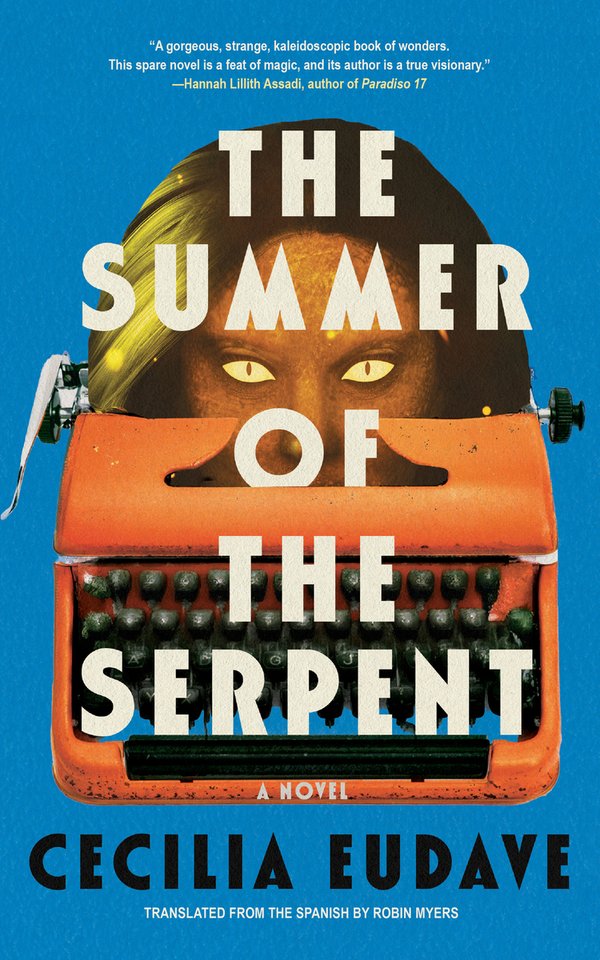
Now translated in English by Robin Myers, The Summer of the Serpent arrives at a moment when competing narratives increasingly shape public life. Throughout the novel, characters struggle to understand one another across differences of age, gender, class, and experience. Even the supernatural elements participate in this struggle: a ghost demands to be heard, while the serpent girl delivers prophecies that begin to make sense in retrospect. Reality, Eudave suggests, is never experienced directly. It is filtered through memory, language, fear, desire, and the stories people tell themselves to survive.
The novel understands that facts alone rarely settle questions of violence, responsibility, or memory. Instead, meaning is produced through interpretation—through the stories individuals, families, and societies construct around what happened. Eudave’s characters are constantly translating experience into narrative, often imperfectly, revealing how easily suffering can be obscured, distorted, or dismissed.
Over several weeks of email exchange, I spoke with Eudave and Myers, with Myers translating Eudave’s responses from Spanish about the book and its translation. We discussed writing violence through the surreal, preserving distinct narrative voices across languages, and the significance of 1977 as a year suspended between eras.
Shandela Contreras: In The Summer of the Serpent, you tell a non-linear story of childhood trauma through six distinct narrative voices that read almost like six different translations of the same summer. Each voice has its own syntax, temporal logic, and relationship to truth. Was there a moment in your creative process when you realized a single voice couldn’t contain what you needed to say?
To write anything, including a translation, you need your ears!
Cecilia Eudave: From the very beginning, I knew I’d need more than one voice to tell this story. I wanted different views of that humid, scaly summer to make room for different emotional angles—and for each reader to identify with one perspective or another. Playing with the past and present in the different narrative voices was another strategy I chose in telling the story, which starts in 1977 and ends in 2017: two years that seem like opposing mirrors, revealing the same atrocities at different moments in time. It feels like all time periods collapse into one; in broad strokes, only the names and actors change.
SC: Each narrative voice in the novel has a distinct register. I found Maricarmén to have an innocent inquiry; Uriel’s voice analytical and precise; the garbage collector has a dreamlike, philosophical quality; Uncle Carlos is passionate and verbose. Robin, when working on the translation, how did you maintain these vocal distinctions from the Spanish text without making them feel artificially differentiated in English?
Robin Myers: Register is the great mystery at work in all writing, which of course includes translation. You can hear it when it’s “right” or “wrong,” but it’s not always easy to break down exactly what makes it so. I admire Cecilia’s use of voice throughout the book, and I approached its vocal range as a challenge and an invitation: to translate her characters in a way that honored their idiosyncrasies while always considering them as part of the novel’s stylistic whole. To write anything, including a translation, you need your ears! There always comes a point in my process when I start reading the manuscript out loud. I find it much easier to pinpoint what a character would or wouldn’t say when I can actually hear it. I have to add that my editors at Soho Press are brilliant and gave me wonderful edits about register (and many other things). One pair of ears is never enough.
SC: Those voices carry such different relationships to time, and that collapse of time is striking—beginning in 1977, the novel opens specifically in Guadalajara “when the world fell apart.” You open by cataloging global catastrophes: political coups, celebrity deaths, the space race collapsing. And then we’re in a neighborhood where children and adults experience their own interior collapses. What drew you to that particular year, and what does it do to have the neighborhood’s intimate, harrowing stories happening in the shadow of documented historical violence?
The novel’s fundamental thesis is about cruelty: Everyone, to a greater or lesser extent, is cruel.
CE: I decided on 1977 because it was the year of the snake in the Chinese zodiac, and also because it contained numerous events that marked the course and conclusion of the 20th century: a century of wars and chaos and unease. At the same time, it was a year when the century seemed to be shedding its skin: It involved the recognition of women’s rights, greater awareness of oppressed countries, the renovation of outmoded educational and social systems, the need for dialogue in response to all kinds of differences. Witnessing the death of a century, we need to consider our global failures on both micro and macro levels; everything that happens in the realm of politics, society, gender, and the economy has an impact on its respective country. In the novel, that means Mexico. The Moderna neighborhood and Calle Francia recreate, in miniature, the vices and virtues played out in Mexican society, which the obsession with cultural and economic globalization imposed by “developed” countries has caused to lose its way. The “ghost of modernity” fractures traditional Mexican values and inflicts new lifestyles that the novel’s characters seek to emulate. Even so, they find themselves overtaken by or trapped in a past of their own, a past in which they recognize themselves—while also finding themselves confronted with a future that forces them abruptly to shed their skin as they aspire to become, and integrate themselves into, a modern country.
SC: In the Moderna neighborhood where these vices play out, a ghost haunts Monika’s family house, and is relentless about being heard. It forces people to listen to its stories and becomes violent when interrupted. The ghost wants its story heard desperately, even if that story is incomplete or incomprehensible. When I was reading, I kept thinking about how trauma works that way—demanding witness even when the experience is shattered and doesn’t fit into coherence. Did you conceive of the ghost this way, or was something else driving its need to be heard?
CE: The ghost in the novel (in Spanish, la fantasma—it’s important that the ghost always be named in the feminine, although it’s a masculine noun) is, in some sense, a metaphor for all gendered affronts and denigration in Mexican society in particular. The horrors inflicted on women of all ages; the atrocities often committed in the places where we’re supposed to be safe. This ghost needs to take care of some unfinished business with herself. She’s carrying a burden of guilt that isn’t hers to bear, but one she’s been forced to. The reader will ultimately understand what they’ve read: The story is constructed in such a way that the discontinuous timeline is essential. And the reader watches and observes depending on how deep they want to go. The interplay of perspectives is important because the novel’s fundamental thesis is about cruelty: Everyone, to a greater or lesser extent, is cruel. I believe that the degree of cruelty we’ve observed or received in childhood is the first doorway onto the violence ultimately exerted in society. I’m proud of this novel because nothing is gratuitous, everything has a reason behind it; all the reader has to do is follow the prophecy of the serpent girl and let every chapter shed its skin.
SC: I’m happy you shared how the ghost should be named. I thought a lot about names as I was reading, the way some of the characters in the novel are referred to by nicknames: the ghost, the serpent girl, the man who collects garbage and comes across his nickname accidentally. In Spanish-speaking cultures and communities throughout the Americas, nicknames—ones earned for personality or behavior, not simply shortened versions of your given name—often give people a sense of belonging. They’re how you’re known. My grandfather was “Showtime” because he danced everywhere; my mom was “Roadrunner” and “Beep Beep” for being relentlessly fast; a relative is “Bembé” because they’re fiery and argumentative. Yet it seems like you’re exploring something different: What happens with belonging when given names are withheld, when someone exists only as a function or a label, these minuscule acts of cruelty one may not even know they’re performing. Were you thinking about the power of naming—or not naming—to construct identity? And do you have nicknames that shaped how you thought about this?
CE: Nicknames are common to the point of omnipresence in Mexico. I couldn’t say whether their use is good or bad. My father would sometimes call me “gacelita” (“little gazelle”) or “flaca”—I was very skinny—and it felt affectionate to me. For the purposes of the novel, though, I used nicknames with the intent to partially obscure the other. When we don’t know someone and don’t want to, a nickname makes it easier to exempt ourselves from the possibility of getting to know them better or even get close. A nickname makes it the bearer’s responsibility to decide whether the tag is positive or negative. In the novel, nicknames are used as a way to protect my relationship with people I actually want to keep my distance from. Real bonds take time to form in Mexico, and while that’s happening, the best way to keep one’s distance is to make assumptions about what someone’s like rather than actually getting to know them. In the novel, Capi, the man who collects garbage, represents a whole social stratum: I can hear it, but it remains circumstantial, transparent. A kind of social ghost that roams the context of my life without concretely becoming part of it.
I always want the reader to co-write the story with me.
SC: In the prose itself, you’re drawing readers very close through sensation. The prose in the novel has remarkable sensory specificity—the texture of sawdust, mold, shed snakeskin at the fair, color draining imagery during moments of conflict with Maricarmen’s family, physical sensations of trembling hands. At these emotional crises, you ground readers in tactile detail rather than explicit psychological explanation. What drew you to crafting the emotional work through images?
CE: I always want the reader to co-write the story with me; through the images I scatter and insinuate throughout, I invite them to recreate and flesh out the narrative as it moves along. When it comes to writing, the devil’s in the details. And those details serve to “tempt” the reader: to spark a hesitation or an emotion they can’t ignore. That’s when they take the plunge. The details are where the answers are.
SC: To speak to those details, Robin, I’m curious how you translated the visceral quality of heat. When I was reading, I felt the feeling of “calor” as it accumulated throughout the novel. How did you find yourself making syntactic or rhythmic choices to convey swelter and stagnation in English?
RM: I love your question in part because, to be honest, I’m not sure I consciously differentiated between the register of heat from the register of everything else in this novel: tense, claustrophobic, a perennial sense of trouble brewing. The swelter and stagnation, as you put it so beautifully, is everywhere in Cecilia’s language, which can be both taut and offhanded. There’s something summery about that double feeling, isn’t it? A casual air with a rumble of thunder in the distance. I didn’t think much of heat as an autonomous entity in the novel as I translated, but I thought all the time about how to achieve that tonal knife-edge between candidness and unease.
One heat-specific example does come to mind, though: Early in the novel, we get “Para el verano lluvioso, caliente y escamoso de 1977, nosotros ya vivíamos en la calle Francia . . . ” A more straightforward translation might be “By the rainy, hot, scaly summer of 1977, we were already living on Francia Street.” But I chose to alter the punctuation: “By the summer of 1977, rainy, scaly, hot, we were already living on Francia Street.” Incorporating those three adjectives as a kind of parenthetical phrase—separating them only with commas—was a rhythmic choice, a way to mark a sensation as relentless, almost invasive.
SC: The father is a translator in the novel, and throughout the book, we’re watching children and adults interpret and “translate” what they witness into their own understanding—sometimes misreading it. Robin, as both a poet and translator, how did your poetic attention to language influence the choices you made while translating Cecilia’s prose, particularly alongside Esteban’s reflections on translation?
The allegory of the ghost is more than a simile or literary device; it’s used as an alternative way to reflect on violence from different angles.
RM: I have a strong affinity for Esteban, a translator of instruction manuals who longs to translate poetry: “But poetry doesn’t put food on the table or cover tuition”. . . I feel you, Esteban. I, too, once had a gig translating manuals (while longing to translate poetry), and I agree with him 100 percent that even technical translation is “more of a creative job than a mechanical one.” Any text, every text, is meant to be reinterpreted, reimagined, resituated in its new linguistic and cultural context. It’s a musical cover. It must transform, and the translator is the person who considers and decides on every single element of its transformation. I experience translation as a practice of respect that’s fueled by curiosity—and curiosity is what makes me feel most free. I translated The Summer of the Serpent in this spirit; it’s what I try to bring to everything I translate. From manuals to poetry.
And poetry is a powerful reminder that language is a material thing. It doesn’t just say; it does, acts, moves. To read a poem (or to write one) invites you to look hard at the physicality of language, the tools and textures it employs to make its mark on you. So does translation. I don’t think my work with poetry has prepared me intrinsically to translate any particular book rather than any other. But I do think it’s taught me to pay attention to the materiality of words, images, and punctuation in a way that helps me approach whatever I’m trying to translate—a poem, a manual, an academic essay, a novel—and consider what it’s made of, what makes it move.
SC: That attention to what language does—not just what it says—feels especially important in a novel where meaning often arrives through metaphor, allegory, and the uncanny. Cecilia, you have a background in what’s called “narrativa de lo inusual”—narratives of the unusual, the unsettling, the surreal. The Summer of the Serpent applies this approach to something very concrete: the neighborhood, a specific summer, childhood trauma. How does formal strangeness serve a story about very real violence and loss? What does the surreal allow you to say about mundane violence that realism cannot?
7 Boundary-Pushing Horror Novels by Latina Writers
The spine-chilling stories will leave you terrified

CE: I’ve always written this way—from my first book, Técnicamente humanos (Technically Human) to this latest one, The Summer of the Serpent. I write about thresholds, moving along the thin line between the real and the strange. From there, like a juggler, I select the best of both sides to build my stories. The creator of the term “narrativa de lo inusual,” Carmen Alemany Bay, expands it to include the idea I’m talking about here, and she adds that what makes it appealing is that the reader can ultimately decide whether they’ve read a realist or surrealist novel. Like you suggest, this could certainly be read as a realist novel with allegorical touches. On another note, I no longer believe that reality as we know it, or as we conceive of it, is enough to help us understand the violence of contemporary life. That’s why we need metaphor, the unusual, the strange, to glimpse what’s hidden from view in the reality we inhabit. In this way, the allegory of the ghost is more than a simile or literary device; it’s used as an alternative way to reflect on violence from different angles. Not just by intellectualizing it, but also by restoring an emotional dimension that makes us more attuned to family and social wounds.
The post An English Language Debut That Translates the Violence Beneath a Neighborhood appeared first on Electric Literature.




 Bengali (Bangladesh) ·
  English (United States) ·