

Professional surfer and scientist Cliff Kapono gets his best ideas when he’s in the ocean. “The thinking turns off, but the ideas start to pour in,” he says. To him, the connection makes complete sense because the native Hawaiian word for “idea” is the same as “wave” — nalu.
Kapono is a native Hawaiian; these are the Indigenous people of Hawaii. He grew up in Hilo, Hawaii, where he is based today, blending his lifelong passions for surfing and science daily. “I want to understand how waves move across our planet, so I can be better at catching these waves,” he says.
As a kid, all he wanted to do was surf every day, all day long. He practiced until he could surf at a professional level. “That’s the same thing that I did in science. It started off where I just wanted to take science classes and get A’s. With surfing, the equivalent is catching nice waves,” Kapono says.
Kapono is now a professional free surfer. These athletes chase the best swells around the world to earn sponsorships and media exposure. He also has time to do scientific research. For Arizona State University’s Center for Global Discovery and Conservation Science in Hilo, he studies how humans and ocean environments interact, from molecular to macro scales, through the lens of a surfer. In this interview, he shares his experience and advice with Science News Explores. (This interview has been edited for content and readability.)
How do you balance professional careers in surfing and science?
When I was younger, I didn’t think I could put the two together. But if I were to pursue a full-time career in either, I would be unhappy. So I figured out a path where I could spend just as much time inside the science lab as I am in the ocean. The Western world defines your job based upon what you get paid to do, not about what you invest your time into. I totally departed from that idea. My job is to be the best version of me. The best version of me is surfing good waves every day and understanding about the natural world through a scientific lens.
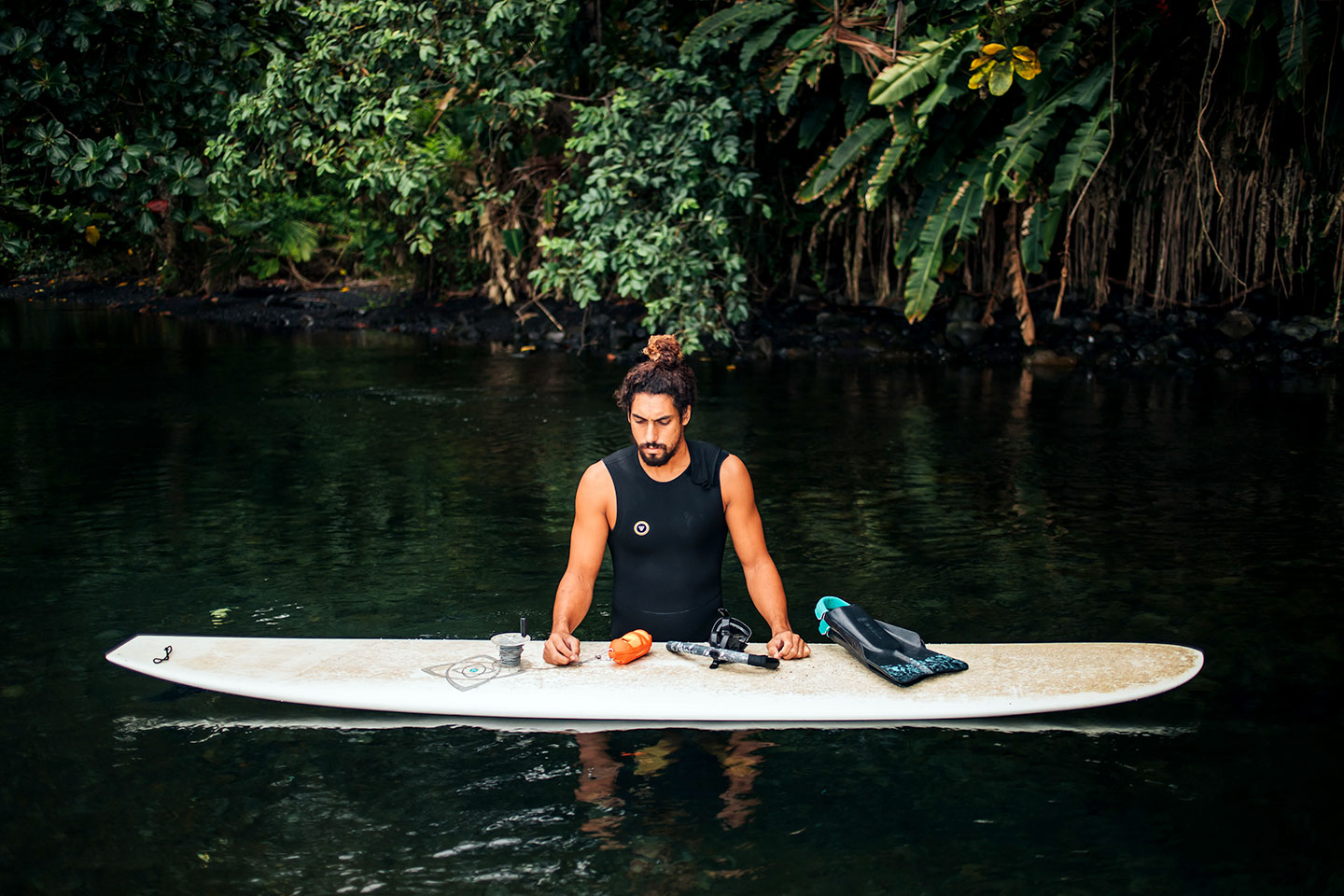 “The best version of me is surfing good waves every day,” Kapono says, “and understanding about the natural world through a scientific lens.”Nani Welch Keliʻihoʻomalu
What does surfing mean to the Native Hawaiian community?
The clearest example of a productive society is the amount of leisure time they have. If you have a highly functioning system, you have surplus time. Our society was able to invest that time into the cultural arts, such as surfing.
Surfing has been documented within our histories for close to 2,000 years. It’s not just recreation. Surfing is so deeply embedded into the Hawaiian culture. It’s in the stories, the chants and the songs. It was celebrated tremendously by all peoples — from folks who were fisher people, farmers, basket weavers, cooks, to the royalty. In the late 1800s, it began being sort of exported outside of Hawaii and demonstrated at different locations around the world. By the 1950s, it reached global fame.
What would you consider one of your biggest successes?
A success for me is elevating scientific literacy within the surf community. As a scientist, I represent an identity in the surf community that didn’t I didn’t see growing up. I can play that role for the next surfer scientist — or maybe it’s a surfer chef or surfer lawyer — to show that you can still contribute on a professional level to multiple communities within society at the same time.
Describe a research breakthrough moment you’ve had.
Explainer: What are corals?
I’m currently trying to identify the structural complexity of reefs at some of the best, most iconic waves around the world. It’s known as bathymetry, the study of the seafloor. I’m looking specifically at where certain famous waves break. Over the last five years, I’ve been traveling around mapping the characteristics of these different reefs. I’m seeing similarities between these waves based upon their reef structure. A personal interest and curiosity is now supported by research — that keeps me excited. Finding out that, by learning more about the reef, I can be a better surfer is a breakthrough for me.
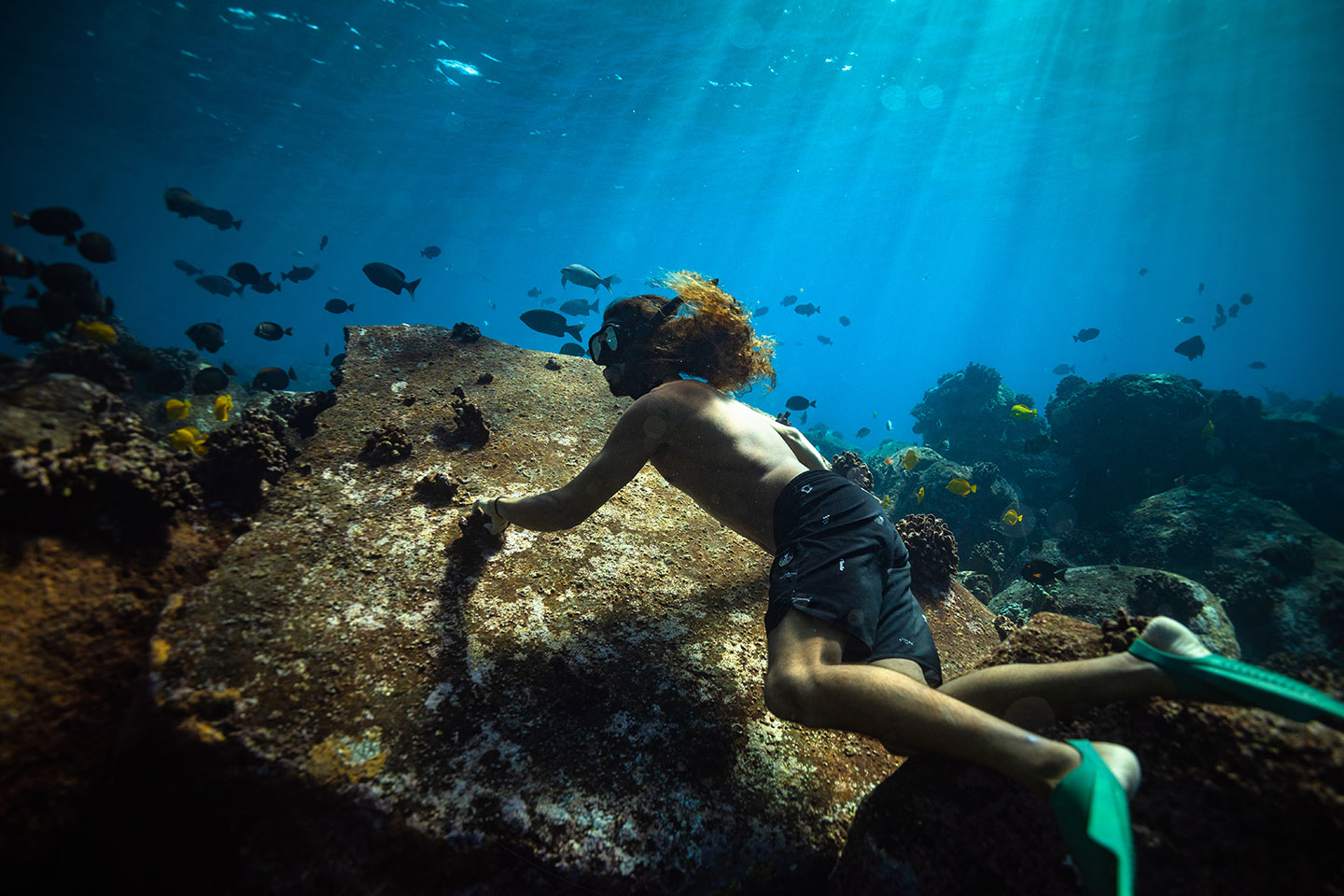 Kapono studies the structural complexity of reefs at some of the best, most iconic wave spots around the world.Sarah Lee
What’s one of your biggest failures, and how did you get past that?
I have gotten a lot of F’s in my academic career, but I’ve never felt like getting an F was a failure. My dad would always tell me that failure is an event, not a person. It’s just a moment that passes, so it’s not going to stay with you very long. So, I’ve actually embraced a lot of failures. I failed at many science experiments. I failed at catching a wave. I fail to ride the wave all the way to the shore. Sometimes I fail to even stand up. I fail in obtaining resources to do my science. I fail in knowing what the right answer is. I fail daily. But failing is not a bad thing if it helps you to find the successes. I don’t feel embarrassed or ashamed to fail anymore. I just tell myself that it’s all going to work out in the end if I don’t let the failure stop me.
Do you have a science question? We can help!
Submit your question here, and we might answer it an upcoming issue of Science News Explores
Who were your role models growing up?
I always looked up to elders in the Hawaiian community that maybe aren’t super famous but, within our communities, really treated me kindly and shared knowledge with me. Whether they were teachers, family members or professional surfers, I always looked up to people who were willing to share what knowledge they had with me. Anybody who helped me to navigate the difficulties of being on an island in a small community and feeling like there’s a bigger world out there. Anybody who helped me to get to a higher level of thinking and develop my intelligence, from my academic intelligence to my emotional intelligence. The people who helped me understand more about the world and myself.
As a professional surfer and professor, Kapono has always pushed himself to succeed in both fields. “The better I got in science, I wanted to make sure I got better at surfing,” he says.What do you do in your spare time?
Let’s learn about coral reefs
I volunteer for a scientific group called Mega Lab that is trying to develop technology to protect the ocean and give it to communities who need it the most. The biggest project we have going on right now is mapping a million reefs by 2030. We’re teaching 10,000 citizen scientists how to map the reef with their GoPro, cell phone or camera. The program is called Map to Adapt. Anyone can join the Mega Lab — artists, skaters, ballerinas or firefighters. There are no requirements, you just come by and start doing science together. We just want to have a good time and party for the planet.
Why do science and surfing fit together so well?
Having an interest in science really has helped me to be a better surfer. And my interest in surfing has helped me to become a better scientist. Science is like a superpower for me. It’s really fun to be able to jump from a community that is so focused on riding a wave into one that wonders about how that wave moves. To me, that’s a pretty epic way to live.

 Bengali (Bangladesh) ·
  English (United States) ·