

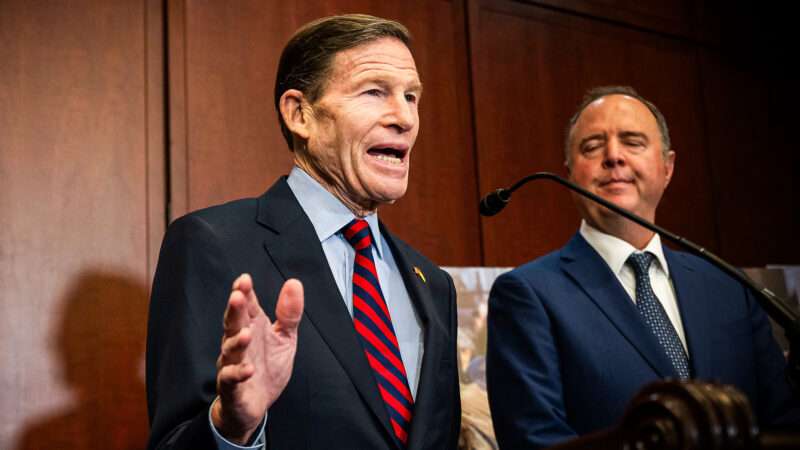
Two Democratic lawmakers introduced a bill in Congress today that would create a right to sue federal law enforcement officers who stop someone from filming or observing police activity.
Sen. Richard Blumenthal (D–Conn.) and Rep. Maxwell Frost (D–Fla.) introduced the "Right to Record Act of 2026," which they say would create new consequences for individual federal officers who violate a person's First Amendment right to document and record police.
The bill's text was not immediately available, but according to a summary of the bill published by Frost's office, the legislation would create a right to sue a federal law enforcement or immigration officer for "preventing or attempting to prevent a person from recording, observing, or peacefully protesting law enforcement activities."
"In addition, officers must not pursue a person to a different location, conduct surveillance of an individual to intimidate them, demand identification from an induvial [sic] because they are recording, or command that an individual stop recording," the summary continued.
The lawmakers cited recent allegations of federal officers targeting videographers in New Jersey, Memphis, and elsewhere across the country, as well as the importance of video evidence in refuting the false government narratives of several shootings of U.S. citizens by immigration agents.
"Over the last year, I've investigated dozens of cases of Americans brutalized by agents of their own government, and across the board, video footage corroborated their testimony – showing the world what they experienced and making sure that justice was served," Blumenthal said in a press release. "Without recordings, we wouldn't know the truth of what happened to Renee Nicole Good, Alex Pretti, Marimar Martinez, George Retes, and so, so many others."
The bill highlights a growing free speech battle: Civil liberties groups say filming the police is a well-established First Amendment right. Although the Supreme Court hasn't directly addressed the issue, seven federal circuit courts have upheld the right to record and monitor the police, so long as one doesn't physically interfere with them. However, Department of Homeland Security (DHS) officials have repeatedly suggested that such activity is doxing and obstruction of justice. Over the past two years, videos from around the country—from Oregon to Maine to the Florida Keys—have shown federal immigration agents arresting or threatening to arrest people for filming them.
The American Civil Liberties Union (ACLU), which endorsed the Right to Record Act, filed a lawsuit in May alleging that a federal police task force in Memphis is systematically retaliating against residents who try to document its activity.
"The right to observe and record law enforcement is fundamental to our democracy," Jenna Leventoff, senior policy counsel with the ACLU, said in a press release. "We can't hold our government accountable if we can't see for ourselves what they're doing in our communities. Observing and filming allows people to create an independent record, share information with their communities, and demand better from our government. Protesting for what we believe in is a core American value, and observing and filming government activity can drive the protest movements that spark change. All of these rights are squarely protected by the First Amendment, and we're hopeful that Congress will codify them into law by enacting the Right to Record Act."
The bill would also be notable, if it passed, because it is currently next-to-impossible under current law and Supreme Court precedent to sue an individual federal law enforcement officer for a constitutional violation.
The DHS did not immediately respond to a request for comment on the legislation.
The post Bill Introduced in Congress To Codify the First Amendment Right To Film the Feds and Sue for Violations appeared first on Reason.com.



 Bengali (Bangladesh) ·
  English (United States) ·