

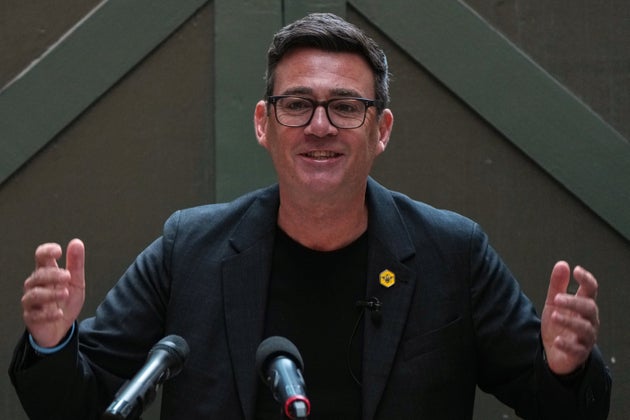
 Labour Party's Andy Burnham delivers a speech at the People's History Museum in Manchester, England, Monday, June 29, 2026.(AP Photo/Alastair Grant)
Andy Burnham is guaranteed to be the next prime minister after 322 Labour MPs nominated him to take over from Keir Starmer.
The huge level of support means that only 81 Labour MPs have not nominated him so far, the minimum needed to get on to the leadership ballot.
But as Starmer is not expected to nominate anyone, it is impossible for anyone else to get the level of support required to mount a challenge.
Burnham will therefore become Labour leader unopposed on July 17, and prime minister on July 20.
In a post on X, the Makerfield MP said: “I am deeply grateful to the 322 Labour MPs who have put their trust in me and nominated me for leader of the Labour Party.
“Their support comes from across the PLP (Parliamentary Labour Party) and reflects a shared belief that Britain needs a new approach to politics. That is the circuit breaker I am offering: power out of Westminster, an economy rewired for ordinary people, and good growth in every postcode.
“I want to empower MPs to bring the experiences of their constituents into the heart of government, and harness the full breadth of our Labour movement, drawing on all its traditions and beliefs in pursuit of a common purpose.
“I want to thank every colleague who has nominated me for their commitment to that vision.”
Eighteen members of Starmer’s cabinet, including chancellor Rachel Reeves, deputy prime minister David Lammy and foreign secretary Yvette Cooper, are among those who nominated Burnham.
Other backers included former health secretary Wes Streeting, who ditched his plan to run for the leadership last week.
Meanwhile, Burnham set out more of his vision for British foreign policy and signalled a tougher stance towards Israel over its military operations in Gaza.
In a video on social media, he apologised for Labour’s previous stance, saying his party “didn’t get it right” and the UK had been “too slow to call for a ceasefire”.
Mr Burnham suggested that his government would “do more to strengthen our approach”, including “looking at further sanctions, both on those involved in the violence in Gaza, but also looking at measures to ban trade in goods with illegal settlements”.
His comments followed an article in The Times in which he said he would seek stability in foreign policy, setting out his commitment to Nato, the nuclear deterrent, maintaining close ties with the US and support for Ukraine as well as closer relations with the EU.
Listen to Commons People, the podcast that makes politics easy. Every week, Kevin Schofield and Kate Nicholson unpack the week’s biggest stories to keep you informed. Join us for straightforward analysis of what’s going on at Westminster.




 Bengali (Bangladesh) ·
  English (United States) ·