
 21 hours ago
11

“What is political?” The artist and one of the founding members of the Black Lives Matter movement Patrisse Cullors asked me this during my recent interview with her about her latest book, We Make the World: Guided Aesthetics Practices for Art, Power, and Healing (HarperOne, 2026). “Coming together to ensure that a pipeline isn’t run through an Indigenous community that will displace everyone—is that really political? Coming together to make a mural that creates more healing between two communities that have experienced harm and to do healing work—is that really political? We have to redefine what is political.”
My student activism began in the age of George Bush’s Global War on Terror, our country’s heightened Islamophobia, and a massive spate of police brutality cases in New York City. When the New York police department shot Amadou Diallo, an unarmed Guinean student, forty-one times, killing him, my activist peers and I held an on-campus protest in condemnation.
One friend created a massive coffin from cardboard boxes, spray-painting it black. From a distance, the makeshift coffin looked real, and as we marched across our college campus, protesting and shouting, “No Justice, No Peace,” students and staff scooted out of classrooms and offices to bear witness at the scene. I chanted until my throat was inflamed and encouraged those on the sidelines to join the demonstration. As my first protest, it was the first time I truly felt free. It was also the first time I’d used my voice to plead for justice and hope, not only for myself, but for others.
After that protest, I became a full-fledged activist. I participated in young activists of color training, collaborated with many activist circles, and I spent my summers working for various community organizing efforts. Being an activist made me feel at the center, and not at the assigned margins due to my race, class, and gender. But activism could be lonely and sometimes isolating. Many friends and family members thought me crazy for protesting and fighting for equality and justice. Unlike me, they did not make the socio-political connections between Islamophobia and police brutality, or between racism and the erosion of civil liberties. They believed, like so many, that the system would automatically correct itself, and so they’d call me “too political.”
In We Make the World, Cullors highlights the convergence of art and activism movements, and provides collaborative and individual guided practices we all can do to bring our community together. “We need art, we need creativity, and we need to reimagine how creativity looks outside of the industry. Lastly, we have to reimagine how we relate to the political format that we’ve been forced into inside of this country in particular.”
It pleased me immensely to speak with Patrisse Cullors via Google Meet about her upcoming book.
This conversation has been edited for length and clarity.
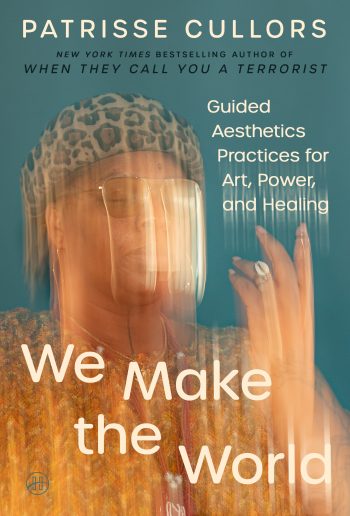
The Rumpus: I wish your book had been around when I was a young activist, but it arrived at a perfect time, when we all feel politically drained, emotionally isolated, and need a fresh breath of hope. You chose to focus on twelve different aesthetics “because it is one of the most powerful technologies we have for making and remaking meaning.” Can you share your book creation process and more about the aesthetic choices?
Patrisse Cullors: My book is my offering to humanity, especially as we are struggling worldwide with a loneliness epidemic, wars, and feeling disconnected from our bodies. I really wanted to create a project where we could study how artists and healers across the world have centered their creative practice to create deeper community connections, to get back to a sense of aliveness, and how this has transformed the world. I’m a list person. I make a list of everything because it helps me to understand and orient my world. My last book, An Abolitionist’s Handbook: 12 Steps to Changing Yourself and the World (St. Martin’s Griffin, 2024), was an instructional guide as well as a list. When I was working on We Make the World, I was thinking about how we can pinpoint these guided practices inside of each of these artists’ and activists’ movements. I also wanted readers to have an extensive and deep creative understanding of each of these categories.
Rumpus: What does it mean to “make meaning?”
Cullors: We shape that world through our understanding. We make meaning by looking at our world—community, block, neighborhood, school, church community—to create the culture we want. We make meaning by initiating change. The more that we give over our rights, our needs, and desires to someone else and say, “You make it happen. You elect an official. You make it happen,” the less we are active and engaging in a new world.
Rumpus: In the preface of We Make the World, you wrote that you chose to focus on aesthetics because it determines “which bodies we see as beautiful and which we see as threatening, which landscapes, which futures we imagine and which remain unthinkable.
Cullors: We live in a place that’s centered around the aesthetics of punishment and of scarcity. We live in a place where only a few people get certain things, and it’s perceived that if the rest of us don’t have these things, then we don’t deserve them. We are living in someone else’s aesthetic, and this is currently determining our reality. The conversation in this book is about aesthetics because I want us to reframe how our society perceives aesthetics, especially when it comes to care. In the book, I want us to think about how artists (not the art market, because that’s an industry) are creating aesthetics that allow us to feel fully alive, engaged, and connected to our communities.
Rumpus: My friend Eloise always says that we live in someone else’s imagination, and we should use this fact to disrupt their reality and create change. We Make the World signals that we can decentralize their imagination, but we can only arrive at this point through art, community, collaboration, and equity.
Cullors: That’s exactly right. As Black people, we know this very well because we’ve lived inside of someone else’s imagination for many centuries. We’ve had to create a new aesthetic reality for ourselves over and over again, not just to cope with the poor conditions we were given, but also to thrive. According to their imagination, we shouldn’t be alive, and yet here we are, making some of the best music, some of the best art, the best comedy, and the best food. Despite them, we are still here. It’s important for us to know that the subject matter of aesthetics is not frivolous. This concept actually makes up our whole reality, and the more we allow someone else’s aesthetic choices to animate our lives, to dictate our lives, the more we lose the ability to be in real connection with ourselves and others.
Rumpus: The more we discuss the topic of aesthetics, the more I see the connection between the aesthetics of reimagining our social reality and the formation of the Black Lives Matter movement, of which you are one of the founding members. The Black Lives Matter movement asks all of us to collectively reimagine a new world where Black bodies are respected, valued, and treated with humanity, not more than anyone else, but just like everyone else.
Cullors: Yes. For me, the Black Lives Matter movement started as a cultural movement before it was a political one. In the book, I write about the Black Arts Movement, the Chicano Arts movement, and the Bauhaus movement because these movements were responding to a time in history in which communities were facing despair, destruction, and yet the creative response was not to shrink, but to make more art. They were using art as a tool to reimagine the culture. The guided aesthetic practices in this book are also asking people to try something else on. If you’re in a funk, if you’re feeling hopeless, use one of these practices: Get your block together, get your family together, try one of them on. You don’t need a facilitator; you just have to practice the art of imagination. In any book that I write, imagination is going to be central because it’s one of the things that we have to keep practicing.
Rumpus: I enjoy your book’s structure. Each chapter focuses on an aesthetic dimension and your personal connection to the aesthetic. You connect these aesthetics to contemporary art history and art movements, case studies, and then you provide guided practices for the readers.
Cullors: When I was working on this book, I was thinking about Julia Cameron’s The Artist’s Way, where she provided artists with pathways to embody their art. I also thought about Thich Nhat Hanh’s mindfulness teachings, and the collaborative art practices I’ve done in the community for decades. Right now, a lot of members in our communities are being asked to shrink, to hide, and to stop speaking about our histories. In my “Voice As Healing Instrument” guided practice, I ask readers to sit in a comfortable place and bring awareness to their voice by trying on different emotional registers. Then I ask them to reintegrate back into their bodies and spend some time journaling about their experience. In this practice, I want readers to unearth and discover, and try something safe and new, in a very risky time in our lives. At a time when we’re really feeling a lot of stuckness, I want this practice to give them joy and encouragement
Rumpus: In a way, the guided practices give readers ownership of the book, and hopefully more ownership of their social reality.
Cullors: Yeah, it’s beautiful that you asked this question. As part of my book tour, I’ve been doing some of these creative practices in various communities. Recently, I was in Santa Ana, which is a community that’s been ravaged by ICE (Immigration and Customs Enforcement) over the last year and a half. I was just in Joshua Tree at the Joshua Tree Music Festival with the queer salon, a community that’s been used as a wedge right now under this administration. In a few weeks, I’ll be going to Topanga, California, to work with folks who’ve been impacted by the fires in the Palisades and Malibu to conduct these guided practices. After my workshop in Long Beach at the Universalist Unitarian Church, one of the community members said to me, “Next time, I’ll do this workshop with my family, and I’m going to try this out…” Her suggestion was completely different from the exercise in the book, and I said to her, “That’s exactly what I want you to do.” These practices are not strict. I want them to be part of an iterative process for the reader. I want the readers to constantly evolve the practices.
Rumpus: I’m in awe of your faith in humanity and your belief that we all can foster creative and constructive changes for ourselves and our community through collaboration. Your book and our conversation remind me that activists and artists are some of the most hopeful people in our world because they see the pain and destruction in our society, and yet, they ask us to imagine new possibilities while being present.
Cullors: For those of us who believe in a new world, who believe we can make a new world, we’re probably the people who also feel the most hopelessness, so we write books and provide guided practices to get ourselves back together. I’m not always hopeful or generous, and this kind of hopefulness takes work, and lots of therapy. That’s why I’ve provided lots of guided practices in my book. There are times when I had to reach for books like mine, so I could just stay alive another moment. But I refuse to let them steal my joy, my creativity, my life force, because I have a child. I am here to be present for not just myself, but also the people around me.
Rumpus: I have noticed in your book, and also during our conversation, you continuously mention the importance of artistically and politically engaging in our community because this fuels collaboration and transformation. Can you talk about why this is important?
Cullors: Unfortunately, sometimes collaborations happen through devastation. For example, when the fires happened in Los Angeles, neighbors and communities had to depend on each other because they could not survive alone. They didn’t have a choice, but to come together. Other times, collaboration happens when people are excited about each other and choose to be in partnership. I think about the Crenshaw Dairy Mart, the organization that I co-founded with my other founders, Noe Olivas and Aliresa Alexander DeReese. We all went to art school together, and we were so inspired by each other’s practices, so after school, we kept working together. We created an institution that other people could be inspired by. So collaboration often happens in the spaces where survival and inspiration are anchored. I want to encourage people to use these practices because we are in a pretty abysmal place right now. I want us to come together collectively to do some real imagination work and healing work.
Rumpus: In your book’s conclusion, you put out a call for all of us to create boldly, dream unapologetically, imagine with your whole being. How are you dreaming boldly and creating with your whole being?
Cullors: I have been dreaming boldly by actively creating. I currently have a group show up right now at the Chapman Guggenheim Gallery at Chapman University. It’s a project I’ve been working on to process this anti-DEI (Diversity, Equity, and Inclusion) narrative that has happened during this time. In the show, I switch the meaning of DEI to mean, “Don’t Ever Integrate.” I’m using this acronym to speak against all of us integrating into white supremacy, patriarchy, homophobia, and transphobia. In this art project, I want to challenge the DEI project and how it fell apart rather quickly. This means that the ideas surrounding DEI were never intentional and meant to create systematic changes, since it fell apart so quickly.
I’ve been dreaming boldly by thinking a lot about the Black and Jewish relationships and how our communities are often pitted against each other. As an artist and healer, I have launched a dialogue series with the Skirball Cultural Center. I want to use that space for our communities to speak about our challenges and the places in which we are really deeply tied. Lastly, at least once a day, I allow myself to think about art and creativity and healing rituals, whether it’s by practicing it or just thinking about it. I smell flowers, and I take a moment to listen to the birds. If I’m with my family in the car, I go, “Wow, look at the ocean. Look at that tree. Did you notice that?” I try to engage in the simplest wonders of life. We cannot forget those wonders. How blessed are we to be able to experience them? That feels important to me.
The post Creative Practice for Creating Deeper Community: A Conversation with Patrisse Cullors appeared first on The Rumpus.



 Bengali (Bangladesh) ·
 English (United States) ·