

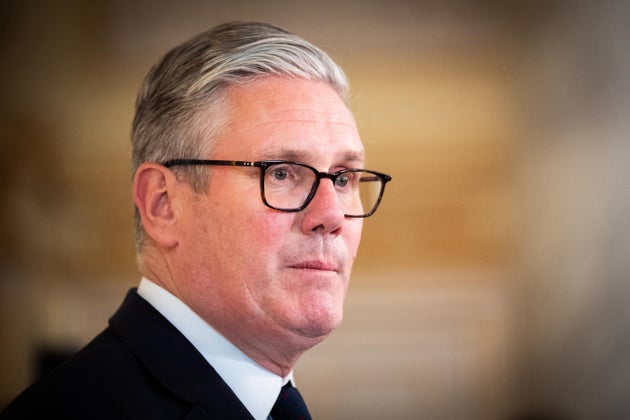
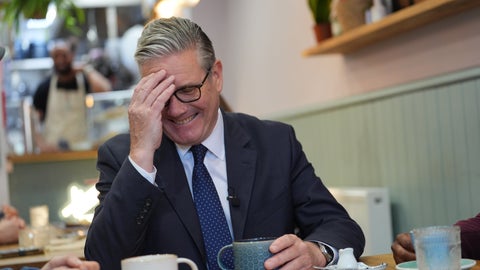
 Keir Starmer speaks to guests during a reception for homelessness charities and organizations who played an influential role in bringing forward the Renters' Rights Act, at number 10 Downing Street, London, Tuesday May 19, 2026.
Minister Chris Bryant had an unenviable job on Wednesday. He had to tell his fellow MPs that the government had made a mistake.
A rather big one, it turned out.
“We have handled this rather clumsily,” he told the Commons. “I think we have ended up giving the wrong impression of what we are trying to do...”
He was, on this occasion, referring to Labour’s confused messaging around the UK’s sanctions against Russian oil, which had caused international bewilderment earlier in the week.
But the minister could have been talking about a number of Labour’s major policies from its two years in office.
This latest saga started when the Department of Business and Trade incorrectly suggested it was going to be easing its sanctions against Russia on Tuesday.
Successive governments have taken pride in the UK’s robust support for Ukraine following Vladimir Putin’s 2022 invasion.
Ministers have regularly announced fresh rounds of penalties against Russia and its lucrative oil industry to squeeze its economy.
So, the apparent decision to effectively water down years of hard work caused instant outrage.
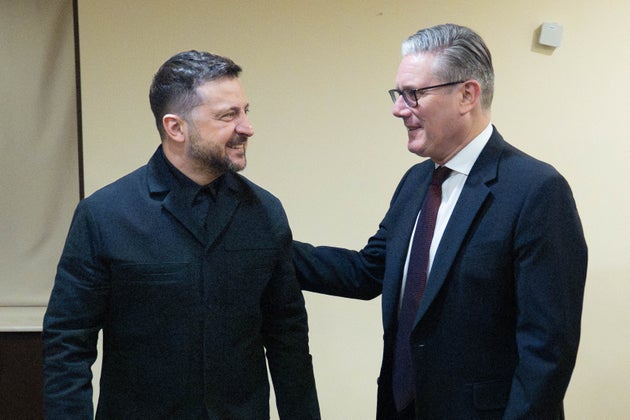 Britain's Prime Minister Keir Starmer (R) and Ukraine's President Volodymyr Zelensky (L) attend a bilateral meeting ahead of the 8th European Political Community (EPC) summit in Yerevan on May 3, 2026.
Tory leader Kemi Badenoch then accused Keir Starmer of “losing his moral compass” during prime minister’s questions.
Labour MP and chair of the Foreign Affairs Select Committee Emily Thornberry slammed the decision, telling the BBC: “People feel very let down.”
Ukrainian president Volodymyr Zelenskyy’s office even approached Downing Street for clarity, amid fears the UK’s support was waning.
It turns out, the initial messaging was wrong.
In reality, Labour was keeping its old sanctions, but had decided to phase in its next batch of penalties – meant to stop Russian oil reaching the UK via third countries – at a slower rate than usual.
The decision stemmed from ongoing concerns about the impact of the Iran war on jet fuel supplies.
Ministers have insisted they still plan on closing that loophole, but not until January 1, due to the uncertainty in the Middle East.
Once Bryant cleared up the confusion in the chamber, concerned Labour MPs told HuffPost UK they felt somewhat reassured – but would be keeping a close eye to make sure the loophole is still closed in the end.
Thornberry wrote on X that she was “relieved” to see clarification from the government, but added: “I only wish there could be a complete ban sooner.”
Even so, Keir Giles, associate fellow of Chatham House’s Russia and Eurasia programme, told HuffPost UK: “It’s all a mess.”
He said the government had sent “mixed messages” and that the “comms cock-up is just horrendous”.
“I could imagine, quite plausibly, that the conversation might have gone, Ukraine saying to the UK, ‘what the hell are you doing?’,” he claimed.
The government also wasted time recovering from another self-inflicted wound this week, after curiously briefing plans to introduce price caps on key supermarket products.
Treasury secretary Dan Tomlinson subsequently told the media they would, in fact, not install a mandatory cap after all.
Even when the government had the opportunity to celebrate what some might see as good news, such as its success with bringing net migration figures down to the lowest rate since the Covid pandemic on Thursday, ministers got distracted.
The government chose to release the files on Andrew Mountbatten-Windsor’s past as a UK trade envoy on the same day, overshadowing migration news.
With more than a dozen U-turns in under 23 months of government, it’s no wonder Labour was thrashed in the elections in England, Wales and Scotland earlier this month.
These policy mix-ups and a conflicted approach to strategy are symptomatic of the primary flaw with Starmer’s government: an inability to communicate.
Even at this most perilous moment for his premiership, he and his ministers are struggling to stay on message – or even decide what that message is.
David Skaith, the Labour mayor of York and North Yorkshire, even admitted to Times Radio that he condemned his party’s approach.
“We’ve not been connecting with the people well enough and our messaging has been terrible,” he said.
“I think hope and belief and confidence in politicians and politics is probably as low as it’s ever been.”
Starmer has also been described as the least popular prime minister of modern times by the pollster Ipsos.
It’s unsurprising wonder that desperate Labour MPs are looking to Greater Manchester mayor Andy Burnham, the party’s most popular politician, to stage a coup.
He has been praised for taking a direct approach to criticism and for his slick social media presence.
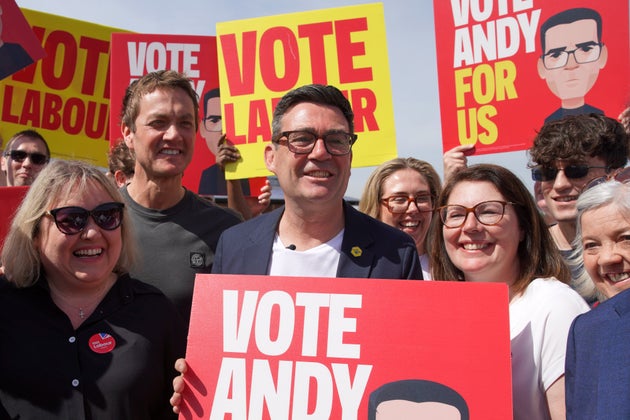 Andy Burnham stands with supporters during the launch of his campaign as Labour's candidate for the Makerfield by-election in Makerfield, England, Friday, May 22, 2026
If Burnham wins the hotly-contested Makerfield by-election next month, MPs are hoping he will take a more radical approach to government.
But the Labour candidate promised on Friday that he would honour the party’s 2024 manifesto until the next general election.
“The main change Burnham would bring is just... vibes,” a Labour insider said. “Though vibes-based politicians are what people want these days.”
Considering a source within party headquarters told HuffPost UK this week that Labour atmosphere is “like a morgue, if that morgue was on a space ship that was hurtling towards certain destruction”, it’s no surprise MPs wants to head in a new direction.
A government insider also admitted Burnham would be “better at the personality side of things and he’s of a more political player,” than Starmer.
However they warned: “His politics won’t be that different”.
“You can only get so far on vibes alone,” another Labour campaigner said.
But, as evidenced this week, it’s often the communication, not the policy, which is the main obstacle for the government.
If Burnham manages to cut through with his more effective “vibes-based” approach, insiders have their fingers crossed that Labour’s fortunes may turn around.
As a senior Labour source added: “Do we have Keir Starmer problem or a Labour problem? We’ll soon find out.”
Subscribe to Commons People, the podcast that makes politics easy. Every week, Kevin Schofield and Kate Nicholson unpack the week’s biggest stories to keep you informed. Join us for straightforward analysis of what’s going on at Westminster.






 Bengali (Bangladesh) ·
  English (United States) ·