

The December 2026 issue of Reason explores Argentine President Javier Milei's accomplishments and what is yet to be done.
 Reason
As the first act of Andrew Lloyd Webber's musical Evita is about to end, Juan Perón mulls his political future. Does he actually want to run for president of Argentina? "All you have to do is sit and wait, keeping out of everybody's way," urges his partner, Eva. "We'll—" She catches herself. "You'll be handed power on a plate."
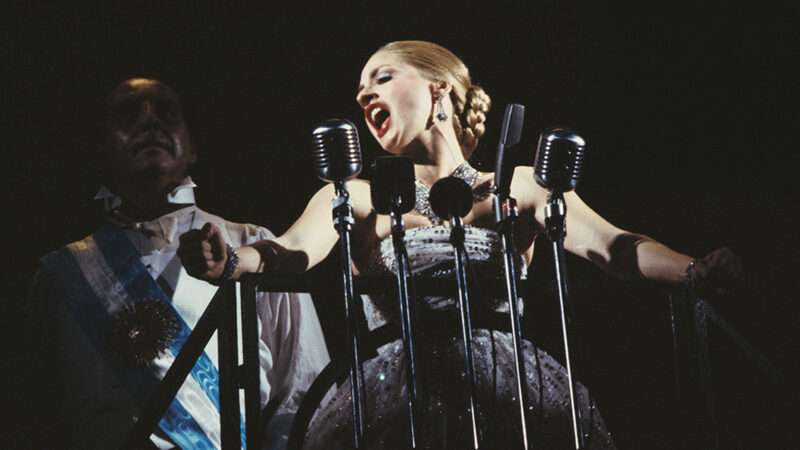
The exchange roughly coincides with when Eva Duarte, the Argentine actress from provincial beginnings, becomes Eva Perón. The scene that has come to define Evita arrives next. At the start of Act 2, she stands on the balcony of the Casa Rosada, the office of the president, and sings "Don't Cry for Me Argentina." Because they—he—ran, and won.
But the moment that should define the show is the former.
There is scant historical evidence that Juan Perón hesitated to run for the presidency. On the contrary, his announcement was electric and decisive. It came the same day as his release from custody, where he had been detained by members of the military who feared his rising influence. Why would he falter? He was, after all, not new to politics or power: Immediately before his brief imprisonment, he served simultaneously as the country's vice president, minister of war, and secretary of labor.
Portraying Eva as the catalyst is dramatically useful, though, and not just for the show. It is a snapshot of how she has lived on in death. Though Evita premiered in London almost five decades ago, it continues to inspire a loyal audience and will make its return to Broadway in 2027. For multiple generations, the musical has been, and will be, many people's primary exposure to the complicated politics and turmoil of Argentina. Yet it contorts that history.There are few historical figures from the last century, after all, who have inspired as much global fascination and lore, because the populism she embodied is itself a form of theater. It requires a particular type of performer. There is a reason the show is not called Juan.
Evita traces Eva's rise, dating back to her arrival in Buenos Aires at 15, when she sets out to overcome her humble upbringing and become a star. (She would go on to achieve minor success in cinema and major success in radio.) At a charity event, Eva meets Col. Juan Perón and seduces him with a promise: She'd "be surprisingly good" for him and his future, should he be interested. The two are effectively inseparable from then on, as they proceed with their ascent to power.
But that's not where the musical begins. We meet Eva when she is dead. An overwrought ensemble says their goodbyes as the group sings a requiem during her funeral Mass; one would be forgiven for wondering if they were praying for Eva or to her. The country we see is in hysterics.
Except our narrator. From the outset, it is apparent he will tell Eva's story through a lens that challenges her—a welcome artistic choice when considering the Peróns' destructive legacy. "Oh, what a circus," he sings, the outcast among throngs of mourners. "Oh, what a show."
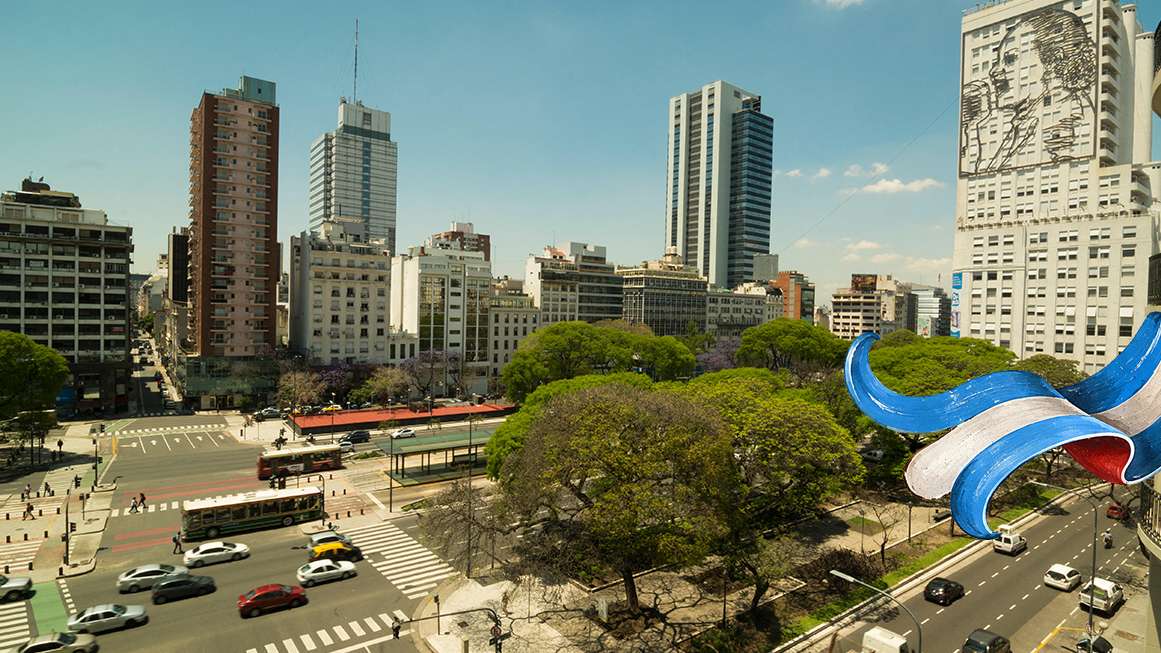 Photo: Mural of Eva Perón on Avenida 9 de Julio in Buenos Aires, Argentina; Bill Bachmann/Alamy
That line takes on new meaning when you realize who he is. The man who will guide us through Evita, promising to dispute the popular narrative that Eva Perón saved Argentina, is Che—as in Che Guevara, the Argentine Marxist known for spreading communism via guerrilla warfare. "Initially, I was planning to tell the story from the point of view of Eva's hairdresser," lyricist Tim Rice told The Guardian in 2014. "But I had a lightbulb moment when I discovered that Che Guevara was from Argentina and had been there when the Peróns were operating. I thought, 'Hang on—Che would be much more interesting than some unknown hairdresser. That way, I get two icons for the price of one.'"
That bargain came at a cost. In Evita, Che is not just a narrator—he is also Eva's chief antagonist, the pair sparring over the course of her life. There is, for one, a rudimentary historical issue: When Juan Perón won the presidential election in 1946, Guevara was 17 years old. When Eva died, he had recently turned 24 and wasn't even in the country. While both may be Argentinian "icons" in a perverse sense, they represent different moments in history, shoehorned bizarrely into the same story because they have name recognition.
But musical historical fiction is not known for its historical fidelity. The bigger issue, accordingly, is not when Che Guevara lived but rather who Che Guevara was.
One exchange in Evita is particularly emblematic of this tension. As Eva is trying to convince Juan not to abandon his bid for the presidency, she summons his defining constituency: labor unions. (This is a nod to the seismic labor protests that prompted the military to release Juan Perón from confinement. How heavy a role Eva played in organizing them is disputed.) Out of the shadows they come. "Now I am a worker, I've suffered the way that you do," she declares. "I've been unemployed and I've starved and I've hated it too."
Che is among them. "A new Argentina, a new age about to begin," he sings. He is flanked by several men, who join him an octave below: "A new Argentina. We face the world together. And no dissent within." They are not, in fact, in this together. The men are enforcers of Perón's censorship, while Che is singing in protest. In the traditional staging, they then assault him and drag him away.
Guevara was intimately familiar with how illiberal movements stifle dissent. In 1959, after violently overthrowing Cuba's Fulgencio Batista—a villain in his own right—and helping install Fidel Castro as prime minister, Guevara oversaw a rash of executions with little or no due process, including for the crime of being a counterrevolutionary.
That was not the beginning. "I fired a .32 caliber bullet into the right hemisphere of his brain which came out through his left temple," Guevara wrote in his diary in 1957, in the heat of the Cuban Revolution. "He moaned for a few moments, then died." "He" was Eutímio Guerra, a peasant army guide, who was accused of passing information to the enemy. "I carried out a very summary inquiry," Guevara wrote of another man, "and then the peasant Aristidio was executed." Faced with reservations about the evidence in Guerra's case, Guevara summed up his approach to disloyalty: "When in doubt," he reportedly told a rebel army commander, "execute."
It was also not the end. In 1960, Guevara established the Guanahacabibes forced labor camp. In some sense, it existed as an act of mercy. Officials "only send to Guanahacabibes those doubtful cases where we are not sure people should go to jail…people who have committed crimes against revolutionary morals to a lesser or greater degree," Guevara said, referring to what many historians have described as a concentration camp. "It is hard labor, not brute labor, rather the working conditions there are hard."
Guanahacabibes was the first of many forced-labor sites used to imprison political dissidents, Catholics, gay people, Afro-Cuban priests, Jehovah's Witnesses, and other outcasts. "Herded into buses and trucks, the 'unfit' would be transported at gunpoint into concentration camps organized on the Guanahacabibes mold," wrote Álvaro Vargas Llosa for The New Republic in 2005. "Some would never return; others would be raped, beaten, or mutilated; and most would be traumatized for life."
Those hellscapes had a slogan imprinted on them: "Work will make you men." That was not entirely original. It resembled the gates of Auschwitz, where prisoners were greeted with a similar sadism: "Work sets you free."
And Guevara is supposed to be our conscience throughout Evita? This is the character complaining of authoritarian excess?
Evita barely touches on those excesses anyway—despite the abundance of material. There are hints scattered throughout. When we first meet Juan Perón, about halfway through Act 1, he is playing musical chairs with other military leaders as they jockey over power. ("When risk is slight/one takes one's stand/with much sleight of hand.") In "And the Money Kept Rolling In (And Out)," Che sarcastically lavishes praise on Eva's charitable foundation—which coerced funds, effectively purchased political support, and helped propagandize her as society's savior. "Now you may feel it should have been a voluntary cause," he levels with the audience. "But that's not the point, my friends." (He also heavily intimates that Eva siphoned funds and hid them in Switzerland, a claim that historians have largely rejected.)
The musical does not interrogate much else of substance. We see Eva appealing to the descamisados—literally "the shirtless ones," a.k.a. the working class—promising to be their defender. "Where there is a need," according to her philosophy, "a right is born." But we do not see how this ethos played out practically, apart from the worship it garnered her. We do not watch the Perón regime's ostensibly labor-friendly policies, its nationalization of core industries, its tariffs, and its hefty price controls sending Argentina's economy up in flames. Nor do we get real exposition, beyond a few brief jabs from Che, of how the couple addressed those who challenged them. That included seizing control of critical media outlets or choking them to death with penalties; using state power to harass and punish opposition politicians; ousting judges and replacing them with hard-line loyalists; and jailing everyday people—not just for dissent, but for the mildest examples of perceived desacato, or disrespect, toward the Peróns.
The most consequential depiction of this comes as a passing summary toward the show's end, when Eva is dying of cervical cancer. "What's new, Buenos Aires?" Che asks, in one of the only spoken moments of the sung-through musical. "Your nation, which a few years ago had the second-largest gold reserves in the world, is bankrupt." (Cuba would like a word.) He continues: "A country which grew up and grew rich on beef is rationing it. La Prensa, one of the few newspapers which dares to oppose Perónism, has been silenced. And so have all other reasonable voices. I'll tell you what's new, Buenos Aires!" It is a wealth of material ripe for drama, condensed into about 30 seconds. That the musical instead fixates almost entirely on the flamboyance of Eva's climb is an apt parallel for the breathlessness of the populism she inhabited.
That is not just its weakness. It is also, for the same reason, Evita's strength. Successful populist leaders are often entertaining to watch, or at least difficult to look away from. It's important for the job. It should be no surprise then that Eva Perón—Evita—makes an exhilarating leading lady.
This electricity manifests most notably in her vocal line. It is relentlessly demanding, lingering constantly in the stratosphere, frequently leaping skyward out of nowhere, and requiring that the actress have the stamina of an Olympic scream belter (screlter for short). "I heard the concept album, and the first thing I said was 'Andrew Lloyd Webber hates women,'" Patti LuPone, who catapulted to icon status herself after originating the role on Broadway, told Los Angeles magazine in 2007. "It was just too high."
Appropriately, "Rainbow High"—the song which introduces Eva's attempted goodwill tour across Europe—is a fitting example of how Webber and Rice wed these vocal demands to the spirit of populist performance itself. As Evita prepares to endear herself to foreign leaders, she readies herself for the part. What is most important? "I'm their savior, that's what they call me," she wails to an audience of beauticians, and perhaps mostly to herself, as she sings of her descamisados. "So Lauren Bacall me, anything goes."
That contradiction strikes at the heart of Eva Perón. In her haute couture wardrobe and Dior ballgowns, worshiped like a queen, she was shirtless. She had to be. "He supports you, for he loves you, understands you, is one of you," she screams on pitch at the close of Act 1, pivoting quickly from rallying Juan to campaigning on his behalf. "If not—how could he love me?"
The post <i>Evita</i>'s Strange Conscience appeared first on Reason Magazine.


 Bengali (Bangladesh) ·
 English (United States) ·