
 42 minutes ago
9

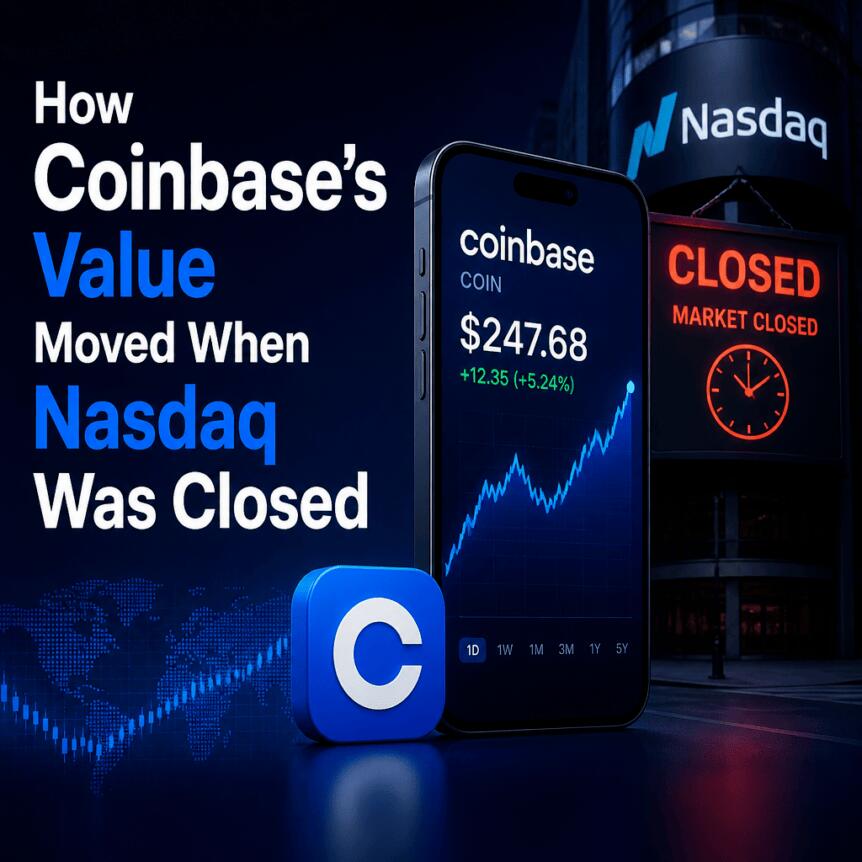
Tokenized stocks have long promised to make equity trading feel closer to crypto—open longer hours, visible settlement mechanics, and execution that doesn’t stop when traditional markets do. A closer look at Coinbase shares traded in tokenized form over Thanksgiving shows how where you measure the price can dramatically change the story.
According to trading activity cited by Public brokerage, a buyer spent 125.49 USDC for tokenized Coinbase exposure on OKXICE during Thanksgiving afternoon while Nasdaq was closed. Using the USDC amount and the tokenized-share price, the purchase implied a roughly 2.4% premium versus Coinbase’s latest traditional closing figure—until after-hours trading prints complicated the comparison.
Key takeaways
A tokenized-stock trade in USDC can reflect holiday liquidity that traditional exchanges do not provide. Comparisons to “the stock price” depend heavily on whether you reference the last close, an intraday reference, or after-hours prints. Blockchain settlement visibility means order costs can be observed directly, not inferred from dealer quotes. Where tokenized shares trade (e.g., OKXICE vs. Tradegate) can introduce timing and currency differences that affect perceived performance. Tokenized equity pricing can appear higher or lower simply due to the reference point chosen for measurement.Thanksgiving liquidity and why tokenized equities still matter
The key feature demonstrated in the Thanksgiving example is that tokenized stocks can keep changing hands even when primary venues are shut. With Nasdaq closed for the holiday, the tokenized market offered a pathway for buyers to gain or add exposure to Coinbase shares without waiting for the next open.
In the cited example, Coinbase had closed on Wednesday at $103.72. Yet the Thanksgiving afternoon token purchase on OKXICE—priced at 106.24 USDC per token—implied the buyer was paying about 2.4% higher than that last close.
But tokenized-equity narratives often fall apart when readers don’t align their time references. If you instead look at the later after-hours benchmark mentioned by Public—where the shares reached $106.91—then the same token trade reads closer to 0.6% lower. The economic direction flips purely because the reference point moved.
How after-hours benchmarks reshape the “price” story
The Thanksgiving trade illustrates a practical problem for anyone tracking tokenized equities: there is no single universal “correct” comparison. Traditional equity markets distinguish between the last regular-session close and subsequent after-hours prints. Tokenized trades can occur in the gaps, meaning a token price can look like a premium or a discount depending on whether you compare it to:
the most recent regular session close (Wednesday’s $103.72 in this case), or an after-hours level that occurred later (Public reports a move to $106.91).In the cited accounting, once the after-hours comparison is used, the purchase that initially looked favorable becomes slightly less so. For investors and traders, the implication is straightforward: when evaluating tokenized stock trades, always confirm what time boundary you’re comparing against—regular close, after-hours print, or another dated reference.
Germany’s Tradegate prints highlight timing and currency effects
A separate datapoint offered in the same account underscores how cross-venue tokenized trading can create additional layers of complexity. The report notes that, early on Thanksgiving, 142 Coinbase shares changed hands on Tradegate at 97.50 euros per share—about $107 at that day’s exchange rate.
Even when two trades involve the “same” underlying equity exposure, differences in venue, execution timing, and FX conversion can make prices appear inconsistent. In practical terms, market participants should treat tokenized-equity prices as venue- and time-dependent, rather than assuming all prints can be compared directly without normalization.
What blockchains add: visible order costs, not just charts
Beyond simple liquidity during market closures, the example points to a more distinctive attribute of tokenized stocks: the trade mechanics are transparent at the transaction layer. The cited account describes a scenario where an investor sees the trade cost precisely because the buyer can open a wallet and execute tokenized exposure over the holiday, with the order cost visible to observers.
The tension here is that transparency cuts both ways. The blockchain can indicate—down to fine precision—what someone paid for “just over one token,” but it cannot guarantee the market will immediately grant the same price to the next participant. For instance, if an observer finds themselves selling $10,000 worth of Coinbase exposure, the question becomes whether the quoted token price is truly available at that moment, or whether buying and selling spread dynamics will result in a different realized execution.
In other words, tokenization improves visibility into how trades occur and what counterparties appear to pay, but execution still depends on order books, timing, and liquidity conditions across venues.
What to watch next
As tokenized equities continue to expand, the most important signal for investors may not be a single “best” price at any given moment, but the consistency of execution across time windows—especially around holidays and outside traditional trading hours. Readers should watch how tokenized markets set reference points relative to regular closes and after-hours prints, since that alignment determines whether a trade looks like a premium, discount, or fair-value move.
This article was originally published as How Coinbase’s Value Moved When Nasdaq Was Closed on Crypto Breaking News – your trusted source for crypto news, Bitcoin news, and blockchain updates.




 Bengali (Bangladesh) ·
 English (United States) ·