
 4 hours ago
5
4 hours ago
5 

In a July 23, 2026 interview with Coin Stories host Natalie Brunell, Thiel discussed the economics behind the Bitcoin mining industry’s increasing interest in artificial intelligence and high-performance computing. His comments, also cited by crypto-focused outlets including BSCN and Wu Blockchain, come as miners look to diversify their businesses amid changing energy economics and rising demand for AI computing capacity.
Thiel also described Bitcoin’s inability to generate native yield for holders as one of the asset’s key weaknesses, while distinguishing that issue from the economics of Bitcoin mining as a business.
MARA Holdings CEO Fred Thiel Highlights Bitcoin’s Yield Limitation
According to reports on the interview, MARA Holdings CEO Fred Thiel said Bitcoin’s biggest weakness is that it does not inherently generate yield for holders.

MARA CEO Fred Thiel identified Bitcoin’s inability to generate yield for holders as one of its key weaknesses in a July 23, 2026, Coin Stories interview. Source: @BSCNews via X
The observation addresses a fundamental difference between Bitcoin and income-producing assets. Bitcoin holders generally rely on price appreciation for returns, unless they use the asset through separate financial products or lending arrangements that introduce additional risks and counterparties.
Thiel’s comments do not appear to represent a rejection of Bitcoin itself. Instead, they reflect the company’s broader assessment of how its energy infrastructure can be deployed to maximize economic returns.
For Bitcoin miners, the distinction is increasingly important. Mining profitability depends on factors such as the Bitcoin price, network difficulty, electricity costs and the efficiency of specialized mining equipment. AI data centers, by contrast, can operate under longer-term agreements with technology companies and other customers that require large amounts of computing capacity.
AI Data Centers Offer Higher Revenue Per Unit of Power
The central point in Thiel’s argument is the relative revenue generated by each megawatt of electricity.
“It’s about $1 million a megawatt all-in, between infrastructure and compute, to build a Bitcoin mining site,” Thiel said in the interview. “The AI site, just the infrastructure without compute, is $10 to $15 million a megawatt.”

Thiel said Bitcoin mining costs about $1 million per megawatt, versus $10–15 million for AI infrastructure, which attracts easier financing through stable, high-revenue contracts. Source: Natalie Brunell via X
The comparison highlights a significant difference in capital requirements. Building AI infrastructure can require 10 to 15 times more investment per megawatt than establishing a Bitcoin mining facility, according to Thiel.
However, the higher upfront cost can be offset by the revenue potential of AI and high-performance computing operations. AI data centers serve customers that require substantial computing resources for applications such as training and running advanced models.
Thiel argued that the economics can also make AI infrastructure more attractive to lenders. Large technology companies and other established businesses can potentially provide long-term contracts or commitments, giving financing institutions greater visibility into future cash flows.
Bitcoin mining does not offer the same contractual revenue structure. Miners instead earn Bitcoin rewards and transaction fees, with the value of those revenues changing alongside the cryptocurrency market and the network’s competitive conditions.
Why Bitcoin Miners Are Exploring AI
The shift toward AI infrastructure has become an important theme across the cryptocurrency mining sector.
Bitcoin miners already operate facilities that require significant amounts of electricity and have experience managing large-scale power infrastructure. Some also control access to energy capacity in locations that could potentially support other forms of computing.

MARA Holdings CEO Fred Thiel said AI data centers generate more revenue per unit of electricity than Bitcoin mining operations. Source: @TheCryptoJonny via X
That has created an opportunity to repurpose existing sites for AI and high-performance computing, although the transition is not straightforward.
AI data centers require substantially different infrastructure from traditional Bitcoin mining facilities. They can demand advanced cooling systems, high-density power delivery, reliable connectivity and specialized equipment. The capital requirements are therefore considerably higher, as Thiel’s comparison suggests.
For companies that can secure financing and customers, however, the potential revenue per unit of electricity can make the investment attractive.
The strategy effectively allows miners to view electricity as a flexible resource that can be allocated to the activity offering the strongest economic return.
MARA Maintains Bitcoin Mining While Exploring AI
MARA has continued to operate as a major Bitcoin mining company while evaluating opportunities in AI and high-performance computing.
The company reportedly has more than 4 gigawatts of energy capacity, providing a substantial base from which to consider future infrastructure development.

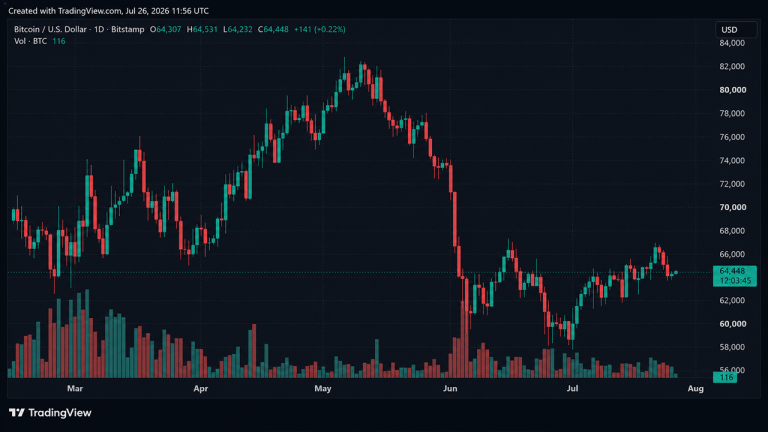
Bitcoin (BTC) price chart. Source: Brave New Coin
Thiel’s comments suggest that MARA’s approach is not necessarily an immediate replacement of Bitcoin mining with AI. Instead, the company can continue mining at existing locations until the economics and infrastructure requirements justify conversion to AI-focused operations.
This approach provides the company with flexibility. Bitcoin mining can continue generating revenue while MARA assesses demand for AI infrastructure, potential customers, and financing opportunities.
The strategy also reflects a broader trend among miners seeking to make greater use of their power assets. As AI companies compete for electricity and data center capacity, access to reliable power has become an increasingly valuable resource.
Bitcoin Mining Faces a Changing Energy Equation
The debate over Bitcoin mining versus AI data centers ultimately comes down to the economics of electricity and infrastructure.
Bitcoin mining is relatively straightforward to deploy at scale compared with advanced AI facilities. Mining machines can be installed and brought online without the extensive construction requirements associated with high-density AI computing.
The trade-off is that mining revenue is highly exposed to market conditions. Bitcoin prices can fluctuate significantly, while the network’s difficulty adjusts as competition changes. Electricity prices also play a major role in determining profitability.
AI data centers require far more capital and technical complexity, but they can potentially operate under commercial arrangements with large customers. These contracts may provide a more predictable revenue profile, which can make expensive infrastructure easier to finance.
This is the calculation behind the industry’s growing interest in AI. The objective is not necessarily to abandon Bitcoin but to determine whether the same power assets can generate greater economic value elsewhere.
For MARA, Thiel’s comments underline the company’s evolving strategy as it balances its established Bitcoin mining operations with opportunities in AI infrastructure. The company’s future direction will depend on factors including Bitcoin’s economics, AI demand, access to capital, customer contracts, and the availability of power.
As MARA Holdings CEO Fred Thiel emphasized, the comparison is ultimately about the return generated from each unit of electricity. For miners with access to large energy resources, that calculation is becoming an increasingly important part of the industry’s long-term business strategy.




 Bengali (Bangladesh) ·
  English (United States) ·