

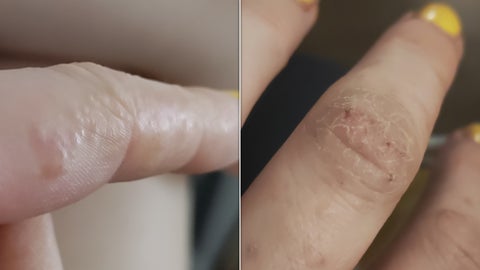
We’ve written about dishydrotic eczema, or pompholyx, before at HuffPost UK.
That shows up as tiny, incredibly itchy, usually flesh-coloured bumps on your hands and feet. It should always be investigated if it’s new and/or if you suspect infection.
But what does it mean if you have little white or yellow lumps by your eye?
Sometimes, these can be milia, or “milk spots,” the Cleveland Clinic said.
Interestingly, they can affect up to 50% of newborns, though they can happen in adults too.
Here’s what chartered chemist and founder of SOS Serum Skincare, Bruce Green, said about them:
What are milia?
These “are tiny, white or yellowish bumps that usually appear on the face, most commonly around the eyes or cheeks. They’re formed when keratin (a protein in the skin) becomes trapped beneath the surface,” Green said.
Milia aren’t formed in the same way as spots and whiteheads, which occur when oil and bacteria gather in a clogged pore.
Instead, dead skin cells slowly build up and can’t escape your skin.
Milia are “completely harmless, but can be frustrating cosmetically,” Green continued.
They’re especially common among newborns – hence the nickname “milk spots” – and adults with thicker, drier skin.
“They can also appear after skin trauma, such as burns, or even from using heavy skincare products that clog the surface of the skin. People with sun-damaged skin may also be more prone,” the expert said.
 Milia
Milia What should I do if I think I have milia?
Luckily, Green told us, most milia will resolve on their own over time.
Still, if you want to speed the process up, “regular gentle exfoliation using chemical exfoliants (like AHAs or BHAs) can help them to clear up and to prevent new ones forming,” Green shared.
Retinol can also increase the rate at which your skin cells turnover, which may help.
“It’s important never to pick at milia, as this can damage the skin. For stubborn or long-lasting milia, professional extraction by a dermatologist or trained aesthetician is the safest option,” the expert continued.
To keep them at bay, maintain a good skincare routine, involving a gentle cleanser, hydrating moisturisers, SPF, and up to twice-weekly gentle exfoliation can help.
“If milia persist or you’d like them removed, it’s best to seek professional help from a dermatologist or trained aesthetician. Trying to extract them at home can damage the skin and increase the risk of scarring or infection,” Green ended.
Watch out for yellow, waxy bumps (xanthelasmas)
These can also develop around the eye area. They’re cholesterol deposits that develop in the skin around the lower eye area and on the eyelid and typically appear as little, pale yellowish bumps.
They can be a sign you have familial hypercholesterolemia (FH), a genetic condition that means your liver can’t process cholesterol properly.
Xanthelasmas are harmless in and of themselves, but they’re linked to an increased risk of heart disease.
You can get a genetic test if you think you may have FH.





 Bengali (Bangladesh) ·
  English (United States) ·