

 Our Place/ ProCook
We hope you love the products we recommend! All of them were independently selected by our editors. Just so you know, HuffPost UK may collect a share of sales or other compensation from the links on this page if you decide to shop from them. Oh, and FYI — prices are accurate and items in stock as of time of publication.
Is there anything worse than a pan whose non-stick fails you after a few short years? Or buying a brand new pan and realising it’s not compatible with your hob?
As someone who’s experienced both, let me tell you: it’s not a situation you want to find yourself in.
As a kitchen essential, a great frying pan can make the difference between food that you want to feast on with your eyes as much as your mouth, and an undercooked, soggy mess.
Too many times have I spent upwards of £100 on a new frying pan only for it to get scratched by the whisper of a utensil.
And I’m sick of it! If you’re anything like me, you’ll want a pan that is not only efficient to cook with, but enhances the flavour of your food, and is easy to wipe clean or chuck in the dishwasher.
Whether you’re looking to upgrade your culinary prowess, or simply want a new pan to add to your collection, I’ve found the best frying pans available on the market right now.
What to consider when buying a frying pan
Hob: Not all pans are compatible with induction hobs, so you’ll need to check before buyingMaterial: Different materials cook, well, differently. Stainless steel pans heat up more evenly than ceramic or non-stick, and can reach higher temperatures, making them more suitable for searing. But, similar to cast iron pans, require treating to make sure they’re non-stick.Ceramic pans are non-stick, which makes them great for cooking eggs.Size: You might want to buy a mixture of sizes for every purpose.Dishwasher-friendly: Some pans can be cleaned in the dishwasher, but most must be cleaned by hand. Make sure you check this before you buy a pan if you have a preference, and also before you chuck it in the machine.
Difference between non-stick, ceramic, stainless steel, and cast iron pans
Traditional non-stick
Pros:
Very easy to use, releases foodVersatileOften cheaper than ceramic, stainless steel or cast iron pansCons:
Some brands use toxic chemicals in the coating, which when damaged can seep into your food. Research each brand before buying to avoidScratched with metal utensils.Ceramic
Pros:
Easy to cleanFewer chemicals than traditional non-stickCan use on high heats, heats up quicklyVersatileEco-friendlyCons:
Hand wash onlyMight not be as durable as stainless steel pans.Stainless steel
Pros:
Don’t contain chemicals like traditional non-stickHeats up quickly and evenlyDurable, they often last for lifeCan be non-stick (but require treating)Lighter than cast ironDishwasher-safeCons:
Takes work to figure out how much heat and fat is needed to make it non-stick.Cast iron
Pros:
Retains heat wellNon-stick when seasonedCons:
HeavyNeeds to be seasoned to prevent rust and make it non-stickHow I chose the best frying pans
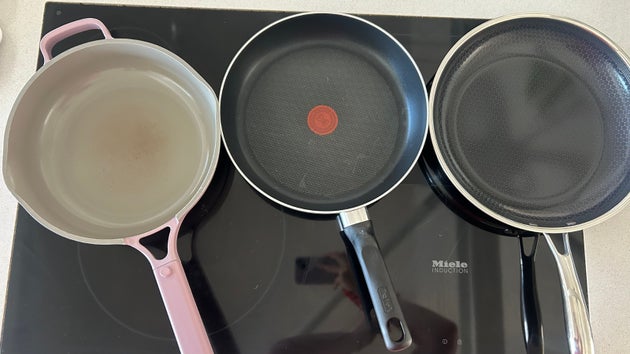 From left to right: Our Place/ Tefal/ Hexclad
As someone who cooks every day, I’m always thinking about how well my frying pan is performing. I tested several of the frying pans on this list, thinking about what they were best for cooking, how much maintenance they required, how non-stick they were compared with what they claimed to be, their size, whether they were dishwasher friendly and whether they were induction hub friendly.
Those I didn’t test myself, I crowdsourced from friends, family, and colleagues. I also read through thousands of reviews to see which were the best rated against the above criteria.



 Bengali (Bangladesh) ·
  English (United States) ·