

Archaeologists have discovered the remains of at least 37 people, some likely dating from more than 1,000 years ago. A large stone “jar” in northern Laos became their last resting place. Part of the mysterious “Plain of Jars,” it’s one of thousands of similar ancient stone vessels. A local legend says giants used the jars to make rice wine. Researchers now think the newfound jar was a multigenerational burial site for ancestor worship.
That would make the Plain of Jars a vast ancient burial complex. Researchers describe this in the August issue of Antiquity.
The newfound stone jar spans more than two meters (6.6 feet) across. It sits in a forest about 70 kilometers (40 miles) northeast of Phonsavan, Laos, in Southeast Asia. Part of the Xieng Khouang Plateau, this region is dotted with thousands of the stone jars.
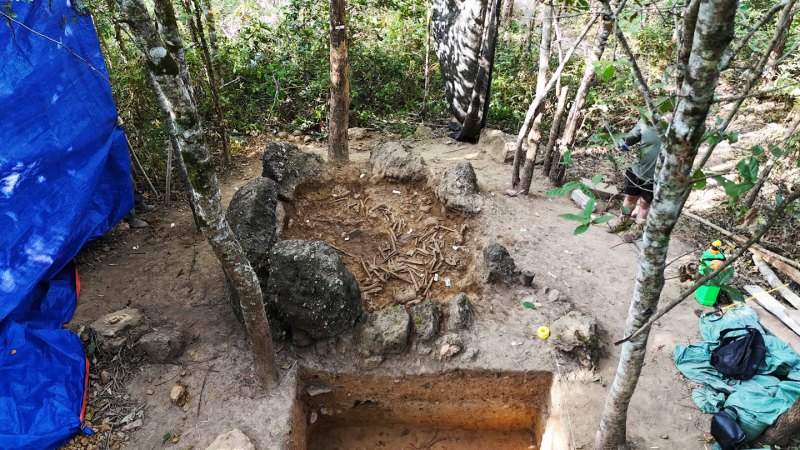 The remains of at least 37 people who died between the 9th and 13th centuries were found in this stone vessel in northeastern Laos. These remains provided key evidence to how the vessels in this Plain of Jars had been used. N. Skopal
The most well-studied groups are around Phonsavan itself. However, the entire plateau is now considered the Plain of Jars.
People had noticed a few of the jars contained bones or some ashes. But it seemed unlikely that so many large stone vessels would have been carved for burial ceremonies. So the jars’ original purpose had been a mystery.
“The big jar we’ve found is unique, and I’ve seen a lot of jars,” says Nicholas Skopal. He’s an archaeologist at James Cook University in the Queensland city of Townsville. This vessel finally confirms that the jars were part of ancient burial ceremonies, he says. But their precise use at different places may have varied.
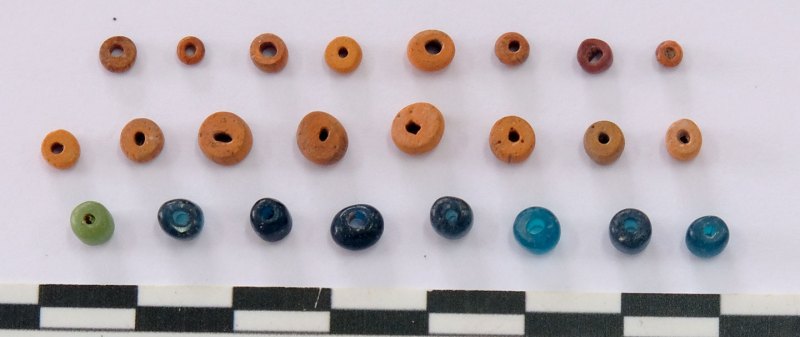 These beads were found in the burial “jar” along with ancient human bones.N. Skopal
Many sets of bones inside the newfound jar are separate. They are not part of a full skeleton. That suggests this jar is a “secondary burial” — a spot chosen for bodies that had partially decomposed elsewhere (such as in smaller jars). There are several smaller jars a short distance away.
“Maybe they used those [smaller] stone jars to ‘distill’ the bodies,” Skopal suggests. Remains might have been put in those smaller jars until “all the flesh comes off,” he says. “Then they take the bones and they put them … in this big jar. So it’s like a big crypt, almost.”
Do you have a science question? We can help!
Submit your question here, and we might answer it an upcoming issue of Science News Explores
The long-standing mystery of the Plain of Jars
French archaeologist Madeleine Colani investigated the stone jars near Phonsavan in the 1930s. Most are just over a meter high (a bit more than 3 feet). Some weigh several tons. Some are lying on their side. A few had stone lids.
Early French explorers had assumed these jars once stored food and water. Colani rejected that. She instead suggested the jars had a burial role.
Scientists largely overlooked this remote region after Colani’s survey. Newer expeditions were hampered by the large number of explosives from the Vietnam War left in this area. Lao officials have been working to clear out the explosives.
Archaeological studies since the mid-1990s found burial pits filled with ancient human remains next to the jars. The remains might have been left there to decompose while awaiting later placement in the jars.
Colani had estimated that the oldest jars could have been made in the 5th century B.C. That would be up to 2,500 years ago. More recent radiocarbon dating indicates the remains are less than half that old — about 1,000 years old. Some jars contained ashes and burned bone fragments, a sign of cremations. This practice is a later, Buddhist tradition. Perhaps the jars were reused for burials after Buddhism took hold in this region, Skopal suggests.
“This is a collective mortuary assemblage,” says Miriam Stark, who did not take part in the new work. “I find that very interesting.” An anthropologist and archaeologist, Stark works at the University of Hawaii at Manoa. She says she had been hoping a jar like the newly studied one would be found.
No sign yet exists of which people might have used the jars for burials, she notes. “I do wonder, where did these people live?”





 Bengali (Bangladesh) ·
  English (United States) ·