

Crypto is red across the board today, and for once the trigger did not come from crypto at all. It came from a single subscription-only tech report about lithography machines in Shanghai. That story took down South Korea's stock market, dragged the entire AI hardware complex with it, and landed on a crypto market that was already sitting on its hands ahead of tomorrow's Federal Reserve decision.
Here is what actually happened, in order of importance.
How far has crypto fallen today?
$Bitcoin broke back below $64,000 on July 28, trading around $63,150 and down roughly 2.8% over 24 hours. It is the third time BTC has cracked that level since July 24, and each break has come with a liquidation cascade attached. Today's flush wiped out about $100 million in leveraged positions inside a single hour. The July 24 version was larger, at roughly $87 million.
Altcoins took the harder hit, as usual:
Ethereum ($ETH): around $1,872, down about 3.5%$XRP: around $1.05, down about 4.4%Solana ($SOL): around $73, down about 4.1%Hyperliquid ($HYPE): around $56, down about 6%Total crypto market capitalisation sits near $2.16 trillion, with Bitcoin dominance above 56%. That dominance number matters: capital is not rotating into altcoins on this dip, it is consolidating into the largest asset or leaving entirely.
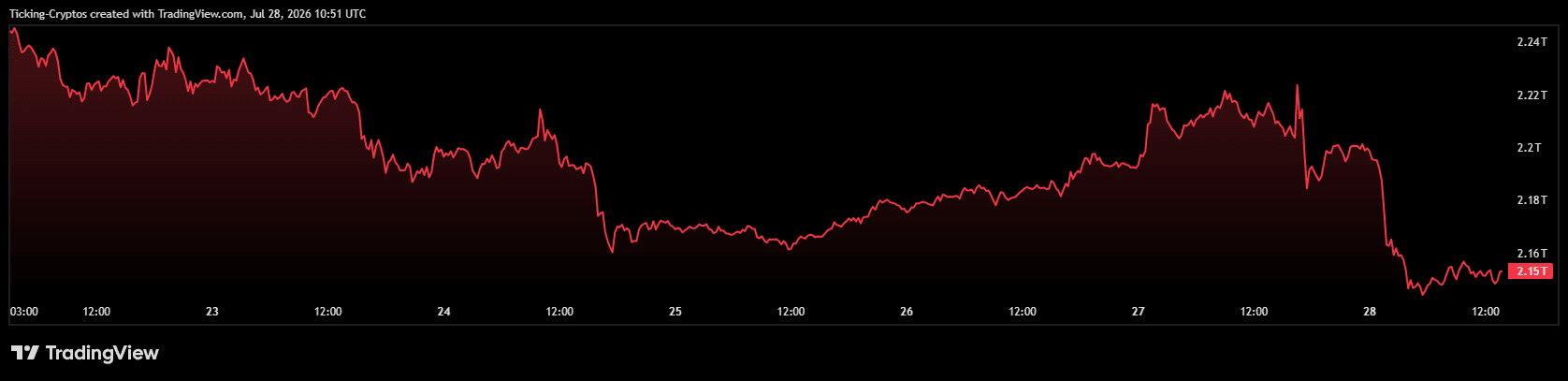 Total Crypto market cap USD
Why did a Chinese chip machine crash the crypto market?
This is the actual catalyst, and it is worth understanding properly because it explains the timing.
On July 27, The Information reported that a Shanghai-based, state-backed manufacturer has started mass-producing immersion deep ultraviolet (DUV) lithography machines. First deliveries go to SMIC, Hua Hong Semiconductor and ChangXin Memory Technologies this year. Volumes are small, roughly five machines in 2026 rising to about twenty in 2027, and the tools reportedly still trail ASML on performance and reliability.
Small volumes, big implications. US and Dutch export controls have blocked China from buying advanced EUV systems, which made ASML's older immersion DUV machines one of its most important China revenue lines. If Chinese fabs can now source comparable tools domestically, that revenue has a ceiling.
Markets did not wait for the qualification data. ASML fell between 6% and 8%. Applied Materials, Lam Research and KLA followed. Then Asia opened and it got worse: the Kospi closed 10.8% lower at 6,023.66, triggering a circuit breaker, with Samsung Electronics down 13.4% and SK Hynix down 14.7%. Between them those two names are close to half the index. The Nikkei fell about 4% and Taiwan's Taiex about 4.7%.
Crypto does not have a lithography exposure. What it has is a correlation problem. Institutional allocators increasingly hold digital assets inside the same technology risk book as AI infrastructure names, so a sector-wide de-risking event sells Bitcoin whether or not the news has anything to do with it.
The closest precedent is DeepSeek's R1 release in January 2025, which triggered an identical one-day repricing of AI infrastructure. AI capex did not actually fall afterwards. It accelerated. Worth remembering before treating today as structural.
Is the Fed decision the real reason crypto is down?
It is the reason nobody is buying the dip.
The FOMC opened its two-day meeting on July 28 under chair Kevin Warsh, with the federal funds rate held at 3.50% to 3.75% for a fourth consecutive meeting. The policy statement lands at 2pm Eastern on July 29.
A hold is the base case. CME FedWatch and prediction markets including Polymarket and Kalshi have put hold probability in the 70% to 93% range through July. The important detail is what the residual probability points at: a hike, not a cut. The reescalation of the Iran conflict and the energy prices that came with it have pushed the entire 2026 rate-cut timeline later across multiple forecasts.
For a market that spent the first half of 2026 waiting for monetary relief, that is the single most bearish framing available. There is no rescue priced in for this month.
Traders are not fully bearish either. Options and leverage positioning has clustered between the $65,000 and $70,000 strikes, and roughly $2.5 billion in notional BTC call spreads expire on July 31. That is why $64,000 keeps getting tested from both sides instead of breaking cleanly.
What does the stalled CLARITY Act mean for crypto?
Washington added a crypto-specific layer to the macro problem.
Senate Majority Leader John Thune confirmed last week that the Digital Asset Market Clarity Act will not pass before the August recess. His exact framing left a crack open, saying he would like to at least get the bill started and see where the votes are, but the arithmetic is unkind. The bill needs 60 votes. Republicans hold 53 seats. No Democrat currently supports the text.
The sticking point is an ethics standoff over conflicts of interest tied to the President's crypto business interests, plus unresolved fights over stablecoin yield restrictions and developer protections.
Prediction markets have repriced accordingly: Polymarket odds on 2026 passage fell to roughly 37%, down from above 80% earlier this year. Industry support has never been broader, with BlackRock, Fidelity, Goldman Sachs and Franklin Templeton all publicly behind the bill, and it still is not enough. Miss the pre-recess window and the next realistic opening is a narrow post-midterm one.
Practically, this means US market structure stays governed by executive orders and agency discretion rather than statute, and DeFi, Layer 2 networks and yield-bearing stablecoins keep operating without legal certainty.
Why does USD/JPY at 164 matter for Bitcoin?
Because it is the one item on this list that can turn a correction into a cascade.
The yen approached 164 per dollar on July 24, a level last seen in 1986, prompting another warning from Japanese authorities that they are prepared to intervene. Japan has already spent roughly $74 billion defending the currency since late April. It did not work, and local commentary has started treating the 160s as the new normal.
That is the setup that concerns leveraged traders. Reporting on July 22 indicated officials are discussing raising rates faster than markets expect, and swap pricing now implies roughly an 80% chance of a hike to 1.25% in October, up from around 70%. If the yen spikes suddenly, whether from intervention or a hawkish surprise, yen-funded carry positions get margin-called and the forced selling hits everything at once. That is the August 2024 playbook, and it took Bitcoin down about 30% at the time.
Nothing has broken yet. But a market this close to an intervention threshold explains why nobody wants size on the books going into a Fed statement.
Are AI spending fears dragging crypto lower?
Yes, and this predates today.
Investors have been openly sceptical about the capital expenditure required for AI infrastructure, and the tape is showing it. SpaceX has erased more than $1.2 trillion in market cap since its June high, falling for the 13th session out of the last 16. Nvidia and the wider AI complex sold off last week even as Bitcoin held near $65,000.
Add thinning demand from the ETF channel. US spot Bitcoin ETFs posted net outflows above $200 million across July 23 and 24, breaking a seven-session inflow streak worth close to $1 billion. Ethereum spot ETFs managed a modest $9.23 million net inflow on July 27, which is functionally flat.
When the largest structural buyer steps back and market depth thins out, the same order flow moves price further. Kaiko has flagged declining depth across major exchanges all year. That is the mechanical reason today's drop feels sharper than the headline percentages suggest.
What happens next for Bitcoin?
Three things resolve inside the next week, and none of them have resolved yet.
The Fed statement arrives July 29 at 2pm Eastern. The CLARITY Act either starts its Senate floor process in early August or it does not. And the July 31 options expiry unwinds the call spread positioning that has been quietly supporting the $65,000 to $70,000 zone.
Levels traders are watching: $64,000 has been the battleground all month, with the June low near $58,000 as the structural floor beneath it. On the total market cap chart, $2.15 trillion is the line that matters. Above it, this is a range. Below it, the June lows come back into play.
Sentiment is already cautious rather than panicked, with the Fear and Greed Index reading in the high 20s. That is not capitulation. It is also not a market positioned for good news.
Want to buy the dip?
You can buy Bitcoin, Ethereum and over 500 other digital assets on Bitpanda. Sign up with code CRYPTOTICKER to get started. Open a Bitpanda account here
Trading the equity side of this story?
Samsung, SK Hynix and ASML are all at the centre of today's selloff. You can trade real stocks and ETFs commission-free on XTB. Open an XTB account here





 Bengali (Bangladesh) ·
  English (United States) ·